
Bibcode
Jeffrey, N.; Whiteway, L.; Gatti, M.; Williamson, J.; Alsing, J.; Porredon, A.; Prat, J.; Doux, C.; Jain, B.; Chang, C.; Cheng, T. -Y.; Kacprzak, T.; Lemos, P.; Alarcon, A.; Amon, A.; Bechtol, K.; Becker, M. R.; Bernstein, G. M.; Campos, A.; Carnero Rosell, A.; Chen, R.; Choi, A.; DeRose, J.; Drlica-Wagner, A.; Eckert, K.; Everett, S.; Ferté, A.; Gruen, D.; Gruendl, R. A.; Herner, K.; Jarvis, M.; McCullough, J.; Myles, J.; Navarro-Alsina, A.; Pandey, S.; Raveri, M.; Rollins, R. P.; Rykoff, E. S.; Sánchez, C.; Secco, L. F.; Sevilla-Noarbe, I.; Sheldon, E.; Shin, T.; Troxel, M. A.; Tutusaus, I.; Varga, T. N.; Yanny, B.; Yin, B.; Zuntz, J.; Aguena, M.; Allam, S. S.; Alves, O.; Bacon, D.; Bocquet, S.; Brooks, D.; da Costa, L. N.; Davis, T. M.; De Vicente, J.; Desai, S.; Diehl, H. T.; Ferrero, I.; Frieman, J.; García-Bellido, J.; Gaztanaga, E.; Giannini, G.; Gutierrez, G.; Hinton, S. R.; Hollowood, D. L.; Honscheid, K.; Huterer, D.; James, D. J.; Lahav, O.; Lee, S.; Marshall, J. L.; Mena-Fernández, J.; Miquel, R.; Pieres, A.; Plazas Malagón, A. A.; Roodman, A.; Sako, M.; Sanchez, E.; Sanchez Cid, D.; Smith, M.; Suchyta, E.; Swanson, M. E. C.; Tarle, G.; Tucker, D. L.; Weaverdyck, N.; Weller, J.; Wiseman, P.; Yamamoto, M.
Bibliographical reference
Monthly Notices of the Royal Astronomical Society
Advertised on:
1
2025
Citations
86
Refereed citations
65
Description
We present simulation-based cosmological wcold dark matter (wCDM) inference using dark energy survey year 3 weak-lensing maps, via neural data compression of weak-lensing map summary statistics: power spectra, peak counts, and direct map-level compression/inference with convolutional neural networks (CNN). Using simulation-based inference, also known as likelihood-free or implicit inference, we use forward-modelled mock data to estimate posterior probability distributions of unknown parameters. This approach allows all statistical assumptions and uncertainties to be propagated through the forward-modelled mock data; these include sky masks, non-Gaussian shape noise, shape measurement bias, source galaxy clustering, photometric redshift uncertainty, intrinsic galaxy alignments, non-Gaussian density fields, neutrinos, and non-linear summary statistics. We include a series of tests to validate our inference results. This paper also describes the Gower Street simulation suite: 791 full-sky PKDGRAV3 dark matter simulations, with cosmological model parameters sampled with a mixed active-learning strategy, from which we construct over 3000 mock dark energy survey lensing data sets. For wCDM inference, for which we allow $-1< w< -\frac{1}{3}$, our most constraining result uses power spectra combined with map-level (CNN) inference. Using gravitational lensing data only, this map-level combination gives $\Omega _{\rm m}= 0.283^{+0.020}_{-0.027}$, ${S_8 = 0.804^{+0.025}_{-0.017}}$, and $w < -0.80$ (with a 68 per cent credible interval); compared to the power spectrum inference, this is more than a factor of two improvement in dark energy parameter ($\Omega _{\rm DE}, w$) precision.
Related projects
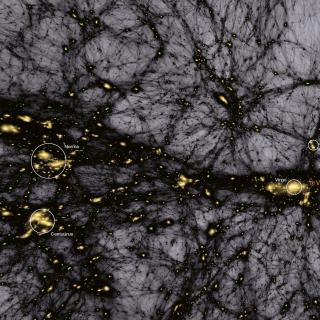
Cosmology with Large Scale Structure Probes
The Cosmic Microwave Background (CMB) contains the statistical information about the early seeds of the structure formation in our Universe. Its natural counterpart in the local universe is the distribution of galaxies that arises as a result of gravitational growth of those primordial and small density fluctuations. The characterization of the
Francisco Shu
Kitaura Joyanes