
Bibcode
Vaduvescu, O.; Hudin, L.; Tudor, V.; Char, F.; Mocnik, T.; Kwiatkowski, T.; de Leon, J.; Cabrera-Lavers, A.; Alvarez, C.; Popescu, M.; Cornea, R.; Díaz Alfaro, M.; Ordonez-Etxeberria, I.; Kamiński, K.; Stecklum, B.; Verdes-Montenegro, L.; Sota, A.; Casanova, V.; Martin Ruiz, S.; Duffard, R.; Zamora, O.; Gomez-Jimenez, M.; Micheli, M.; Koschny, D.; Busch, M.; Knofel, A.; Schwab, E.; Negueruela, I.; Dhillon, V.; Sahman, D.; Marchant, J.; Génova-Santos, R.; Rubiño-Martín, J. A.; Riddick, F. C.; Mendez, J.; Lopez-Martinez, F.; Gänsicke, B. T.; Hollands, M.; Kong, A. K. H.; Jin, R.; Hidalgo, S.; Murabito, S.; Font, J.; Bereciartua, A.; Abe, L.; Bendjoya, P.; Rivet, J. P.; Vernet, D.; Mihalea, S.; Inceu, V.; Gajdos, S.; Veres, P.; Serra-Ricart, M.; Abreu Rodriguez, D.
Bibliographical reference
Monthly Notices of the Royal Astronomical Society, Volume 449, Issue 2, p.1614-1624
Advertised on:
5
2015
Citations
17
Refereed citations
13
Description
Since 2006, the European Near Earth Asteroids Research (EURONEAR)
project has been contributing to the research of near-Earth asteroids
(NEAs) within a European network. One of the main aims is the
amelioration of the orbits of NEAs, and starting in 2014 February we
focus on the recovery of one-opposition NEAs using the Isaac Newton
Telescope (INT) in La Palma in override mode. Part of this NEA recovery
project, since 2014 June EURONEAR serendipitously started to discover
and secure the first NEAs from La Palma and using the INT, thanks to the
teamwork including amateurs and students who promptly reduce the data,
report discoveries and secure new objects recovered with the INT and few
other telescopes from the EURONEAR network. Five NEAs were discovered
with the INT, including 2014 LU14, 2014 NL52 (one very fast rotator),
2014 OL339 (the fourth known Earth quasi-satellite), 2014 SG143 (a quite
large NEA), and 2014 VP. Another very fast moving NEA was discovered but
was unfortunately lost due to lack of follow-up time. Additionally,
another 14 NEA candidates were identified based on two models, all being
rapidly followed-up using the INT and another 11 telescopes within the
EURONEAR network. They include one object discovered by Pan-STARRS, two
Mars crossers, two Hungarias, one Jupiter trojan, and other few inner
main belt asteroids (MBAs). Using the INT and Sierra Nevada 1.5 m for
photometry, then the Gran Telescopio de Canarias for spectroscopy, we
derived the very rapid rotation of 2014 NL52, then its albedo,
magnitude, size, and its spectral class. Based on the total sky coverage
in dark conditions, we evaluate the actual survey discovery rate using
2-m class telescopes. One NEA is possible to be discovered randomly
within minimum 2.8 deg2 and maximum 5.5 deg2.
These findings update our past statistics, being based on double sky
coverage and taking into account the recent increase in discovery.
Related projects
Kinematic, Structural and Composition Studies of the Interstellar and Intergalactic Media
The basic objective of the broject is to investigate the evolution of galaxies by deepening our understanding of the interaction between the insterstellar medium and the stars.The main technique which we use is the two-dimensional kinematic study of whole galaxies observed using our instrument:GHaFaS, a Fabry-Perot interferometer on the William
Prof.
John E. Beckman

Milky Way and Nearby Galaxies
The overall aim of the project is to study the morphology, stellar populations, kinematics and dynamics (including formation and evolution) of the Milky Way and its satellite galaxies and other Local Group galaxies. The project can be divided into two main lines: I. Structure of the Milky Way and nearby galaxies. The detailed study of the
Martín
López Corredoira
Small Bodies of the Solar System
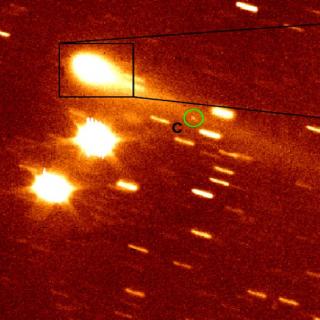
This project studies the physical and compositional properties of the so-called minor bodies of the Solar System, that includes asteroids, icy objects, and comets. Of special interest are the trans-neptunian objects (TNOs), including those considered the most distant objects detected so far (Extreme-TNOs or ETNOs); the comets and the comet-asteroid
Julia de
León Cruz