
Bibcode
Spiniello, Chiara; Radovich, Mario; Ferré-Mateu, Anna; De Propris, Roberto; Arnaboldi, Magda; La Barbera, Francesco; Hartke, Johanna; D'Ago, Giuseppe; Tortora, Crescenzo; Bevacqua, Davide; Maksymowicz-Maciata, Michalina; Mills, John; Napolitano, Nicola R.; Pulsoni, Claudia; Saracco, Paolo; Scognamiglio, Diana
Bibliographical reference
Monthly Notices of the Royal Astronomical Society
Advertised on:
5
2025
Citations
0
Refereed citations
0
Description
We report the discovery of emission lines in the optical spectra of ultracompact massive galaxies (UCMGs) from INSPIRE including relics, which are the oldest galaxies in the Universe. Emission-lines diagnostic diagrams suggest that all these UCMGs, independently of their star formation histories, are 'retired galaxies'. They are inconsistent with being star-forming but lie in the same region of shock-driven emissions or photoionization models, incorporating the contribution from post-asymptotic giant branch (pAGB) stars. Furthermore, all but one INSPIRE objects have a high [O II]/H$\alpha$ ratio, resembling what has been reported for normal-size red and dead galaxies. The remaining object (J1142+0012) is the only one to show clear evidence for strong active galactic nucleus activity from its spectrum. We also provide near-UV (far-UV) fluxes for 20 (5) INSPIRE objects that match in GALEX. Their ${\rm NUV}-r$ colours are consistent with those of galaxies lying in the UV green valley, but also with the presence of recently ($\le 0.5$ Gyr) formed stars at the sub-per cent fraction level. This central recent star formation could have been ignited by gas that was originally ejected during the pAGB phases and then re-compressed and brought to the core by the ram-pressure stripping of Planetary Nebula envelopes. Once in the centre, it can be shocked and re-emit spectral lines.
Related projects
Nuclear Activity in Galaxies: a 3D Perspective from the Nucleus to the Outskirts
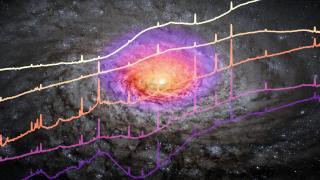
The group has two main research lines. First, the study of quasar-driven outflows in luminous and nearby obscured active galactic nuclei (AGN) and the impact that they have on their massive host galaxies (AGN feedback). As part of this project, QSOFEED (Quasar Feedback), we have obtained Gran Telescopio CANARIAS (GTC) infrared and optical
Cristina
Ramos Almeida
Traces of Galaxy Formation: Stellar populations, Dynamics and Morphology
We are a large, diverse, and very active research group aiming to provide a comprehensive picture for the formation of galaxies in the Universe. Rooted in detailed stellar population analysis, we are constantly exploring and developing new tools and ideas to understand how galaxies came to be what we now observe.
Anna
Ferré Mateu