
Bibcode
López-Corredoira, Martín
Bibliographical reference
The Astrophysical Journal
Advertised on:
1
2025
Journal
Citations
4
Refereed citations
4
Description
Vertical stellar kinematics+density can be used to trace the dark matter distribution (or the equivalent phantom mass in a Modified Newtonian Dynamics (MOND) scenario) through the Jeans equations. In this paper, we want to improve this type of analysis by making use of the recent data of the 6D information from the Gaia DR3 survey in the anticenter and the Galactic poles to obtain the dynamical mass distribution near plane regions, including extended kinematics over a wide region of 8 kpc < R < 22 kpc, ∣z∣ < 3 kpc. Our conclusions are as follows: (i) the model of the spherical dark matter halos and the MOND model are compatible with the data; (ii) the model of the disky matter (with density proportional to the gas density) is excluded; (iii) the total lack of dark matter (there is only visible matter) within Newtonian gravity is compatible with the data; for instance, at solar Galactocentric radius, we obtained Σ = 39 ± 18 M ⊙ pc‑2 for z = 1.05 kpc, compatible with the expected value for visible matter alone of 44 M ⊙ pc‑2, thus allowing zero dark matter. Similarly, for R > R ⊙, z = 1.05 kpc, Σ = 28.7 ± 9.6, 23.0 ± 5.7, 16.9 ± 5.8, and 11.4 ± 6.6 M ⊙ pc‑2, respectively, for R = 10, 13, 16, and 19 kpc, compatible with visible matter alone. Larger error bars in comparison with previous works are not due to worse data or a more awkward technique but to a stricter modeling of the stellar distribution.
Related projects

Milky Way and Nearby Galaxies
The overall aim of the project is to study the morphology, stellar populations, kinematics and dynamics (including formation and evolution) of the Milky Way and its satellite galaxies and other Local Group galaxies. The project can be divided into two main lines: I. Structure of the Milky Way and nearby galaxies. The detailed study of the
Martín
López Corredoira
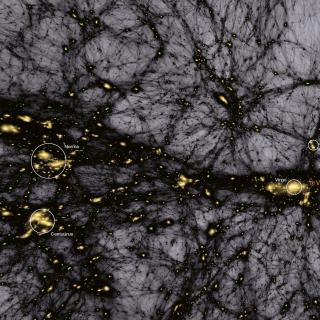
Cosmology with Large Scale Structure Probes
The Cosmic Microwave Background (CMB) contains the statistical information about the early seeds of the structure formation in our Universe. Its natural counterpart in the local universe is the distribution of galaxies that arises as a result of gravitational growth of those primordial and small density fluctuations. The characterization of the
Francisco Shu
Kitaura Joyanes