
Bibcode
Ferreira, F. S.; Camargo, J. I. B.; Boufleur, R.; Banda-Huarca, M. V.; Pieres, A.; Peixoto, V. F.; Assafin, M.; Bernardinelli, P. H.; Lin, H. W.; Braga-Ribas, F.; Gomes-Junior, A.; Vieira-Martins, R.; da Costa, L. N.; Abbott, T. M. C.; Aguena, M.; Allam, Sahar S.; Alves, O.; Annis, J.; Bacon, D.; Brooks, D.; Burke, D. L.; Carnero Rosell, A.; Carretero, J.; Desai, S.; Doel, P.; Everett, S.; Ferrero, I.; Frieman, J.; García-Bellido, J.; Gatti, M.; Gaztañaga, E.; Giannini, G.; Gruen, D.; Gruendl, R. A.; Herner, K.; Hinton, S. R.; Hollowood, D. L.; Honscheid, K.; James, D. J.; Kuehn, K.; Lee, S.; Marshall, J. L.; Mena-Fernández, J.; Miquel, R.; Myles, J.; Palmese, A.; Plazas Malagón, A. A.; Pereira, M. E. S.; Samuroff, S.; Sanchez, E.; Sanchez Cid, D.; Servila-Noarbe, I.; Smith, M.; Suchyta, E.; Swanson, M. E. C.; Tarle, G.; To, C.; Tucker, D. L.; de Vicente, J.; Vikram, V.; Walker, A. R.; Weaverdyck, N.
Bibliographical reference
Monthly Notices of the Royal Astronomical Society
Advertised on:
6
2025
Citations
4
Refereed citations
2
Description
We identified known Trans-Neptunian Objects (TNOs) and Centaurs in the complete Dark Energy Survey (DES) year six catalogue (DES Y6) through the Sky Body Tracker (SkyBoT) tool. We classified our data set of 144 objects into a widely used 4-class taxonomic system of TNOs. No such previous classification was available in the literature for most of these objects. From absolute magnitudes and average albedos, an estimation of the diameters of all these objects is obtained. Correlations involving colours, orbital parameters, dynamical classes, and sizes are also discussed. In particular, our largest reddest object has a diameter of $390^{+68}_{-53}$ km and our largest cold classical, $255^{+19}_{-17}$ km. Also, a weak correlation between colour and inclination is found within the population of resonant TNOs in addition to weak correlations between colour and phase slope in different bands.
Related projects
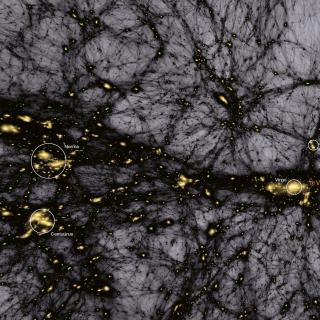
Cosmology with Large Scale Structure Probes
The Cosmic Microwave Background (CMB) contains the statistical information about the early seeds of the structure formation in our Universe. Its natural counterpart in the local universe is the distribution of galaxies that arises as a result of gravitational growth of those primordial and small density fluctuations. The characterization of the
Francisco Shu
Kitaura Joyanes