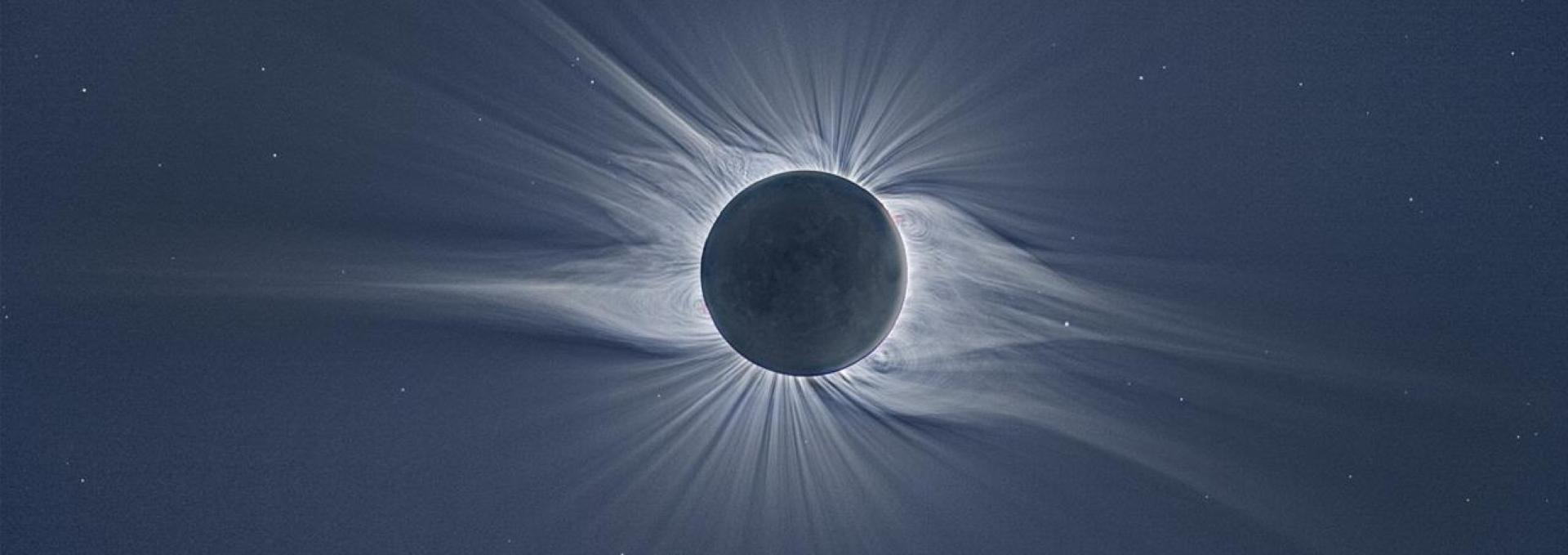
Total solar eclipses are one of nature’s most breathtaking phenomena. Day suddenly yields to a brief darkness, revealing bright stars, planets, and the ethereal solar corona— the outermost layer of the Sun’s atmosphere, usually hidden by the intense glare of inner layers. Beyond their visual wonder, eclipses serve as scientific laboratories. They reveal the subtle orbital dynamics of the Sun-Earth-Moon system, enable detailed studies of the enigmatic solar corona and lunar topography, and historically provided the crucial observations needed to test Einstein’s Theory of General Relativity.
The Upcoming Solar Trio
Europe—and Spain in particular—is preparing for what will be the trio of solar eclipses of the century: two total solar eclipses and one annular eclipse traversing the Iberian Peninsula in less than 18 months.
On 12 August 2026, the first total solar eclipse visible from continental Europe since 1999 will take place. The Moon’s shadow will pass over the Arctic Ocean, Greenland and Iceland before sweeping west-to-east across Spain. With a totality path nearly 300 km wide crossing major population centers in Spain, millions will witness a spectacular eclipsed sunset.
On 2 August 2027, the longest total solar eclipse of the 21st century (Statistics for Solar Eclipses, NASA Eclipse Website) will cross the Strait of Gibraltar, North Africa and the Middle East. Lasting for a maximum of 6 minutes and 23 seconds, the Moon will completely block out the Sun, creating an unforgettable twilight in the middle of the day.
Closing the trio, on 26 January 2028, an annular solar eclipse will feature the famous "Ring of Fire," where the Moon is slightly further from Earth and leaves a brilliant solar ring exposed. Originating in the Pacific Ocean and traversing much of South America, its path finishes across Portugal and Spain.
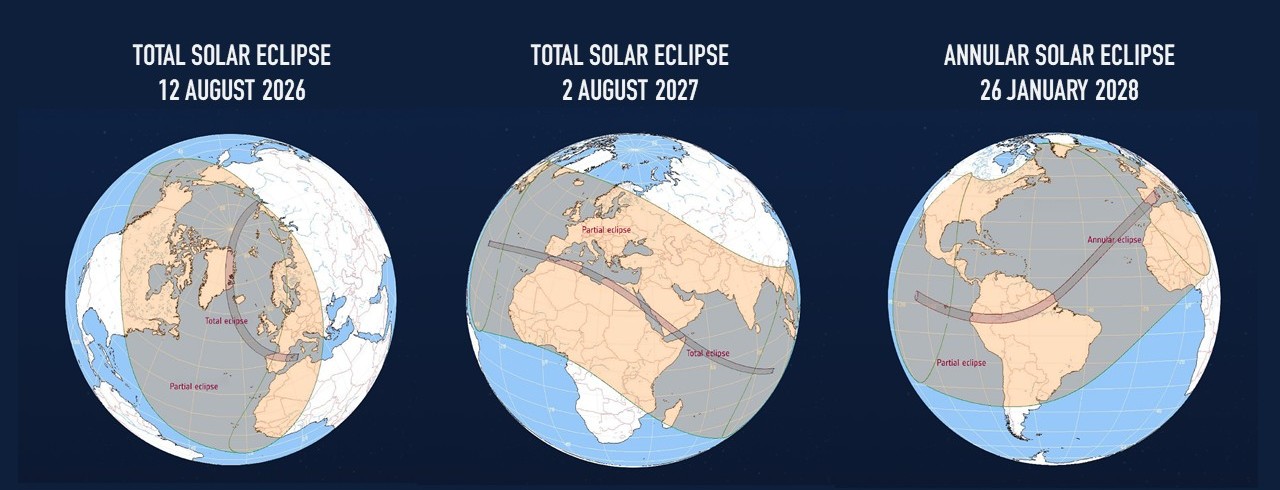
Additionally, these events will be visible as partial solar eclipses across wide regions of Europe, the Americas and Africa.
A Window of Opportunity for STEM Education
This trio of solar eclipses, unusual due to its geographical concentration in such a short timeframe, offers us a unique opportunity to spark interest in understanding our star and our immediate planetary neighborhood.
Aware of the significance of this astronomical milestone, the National Astronomy Commission of Spain established a dedicated working group: the Scientific and Advisory Commission for the Eclipse Trio (CCATE, according to its Spanish acronym). CCATE focuses its activity on four key areas: science outreach, education, citizen science and the organisation of observation and dissemination events.
Within CCATE, specialized teams have been established, including the Education team. Our explicit goal is to transform the public fascination generated by these astronomical events into deep and meaningful learning experiences.
One of our main lines of action has been collecting, selecting, and creating educational resources designed to make solar physics and eclipse science easy to understand. These materials come in a wide variety of formats—teaching guides, didactic units, workshops, activities featuring real solar imagery, games, and outreach videos—to reach students of all ages and interests. All resources are published openly on the Spanish Astronomical Society website.
To empower educators, CCATE partnered with Spain’s Ministry of Education to launch the open online course "The Sun and the 2026–2028 Eclipse Trio". The training covers everything from fundamental solar physics and eclipse mechanics to safe observation practices and the historical and artistic impact of eclipses. Core concepts are presented through short video modules paired with practical activities and workshops. The first edition ran from May to June 2026 with more tan 2,600 participants, and two additional editions will run in 2027 to support upcoming events.
Research and Citizen Science in Action
The eclipse trio acts as a major catalyst for scientific engagement. A key initiative is the North African Telescope Eclipse (NATE)project led by the Instituto de Astrofísica de Canarias (IAC).
Designed to study the solar corona during the August 2, 2027 eclipse, NATE will deploy a coordinated network of telescopes along the totality path to track coronal dynamics for over 10 consecutive minutes. The data will be gathered and analyzed by collaborative teams of researchers from the IAC and the U.S. National Solar Observatory (NSO), alongside teachers and students from the Canary Islands and Morocco.
As a field test, NATE teams will gather in Palencia, Spain, during the August 12, 2026 eclipse for real-time telescope calibration, while offering a full outreach program in the region. If you are near Palencia between August 8 and 12, we invite you to explore the wide range of outreach talks, workshops, and safe, inclusive solar observation activities organized by NATE.
For those unable to attend in person, the IAC will stream the eclipse live on its YouTube channel.
Looking Ahead: A Legacy Beyond the Shadow
By bridging cutting-edge research and public education, the 2026–2028 Eclipse Trio is far more than a celestial spectacle—it is an invitation for students to discover their passion for science, for researchers to push the boundaries of solar physics, and for humanity to look up together in shared wonder.
Written by Nayra Rodríguez Eugenio, Coordinator of Education Projects at the IAC and National Astronomy Education Coordinator for Spain (IAU)