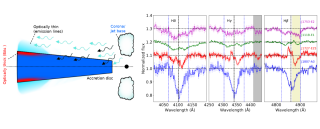

The Necklace nebula is a bipolar, post-common-envelope planetary nebula, the central star of which has been shown to have a dwarf carbon star companion. We aim to understand the origins of the Necklace and its dwarf carbon central star. We study the carbon abundance of the nebula through far-ultraviolet spectroscopy obtained with the Hubble Space Telescope. Furthermore, through simultaneous modelling of multi-band light and velocity curves, we attempt to constrain the parameters of the central star system. Puzzlingly, we find that the region of the inner nebula observed with the Hubble Space Telescope is seemingly not carbon-rich, at odds with the dwarf carbon star nature of the companion of the central star. The initial mass of the nebular progenitor was likely very close to the limit to become carbon-rich, perhaps experiencing a very late thermal pulse. The dwarf carbon star companion is found to be significantly inflated with respect to that expected for an isolated main-sequence star of the same mass. The properties of the central binary are consistent with the progenitor having become carbon-rich and its companion having accreted a significant amount of that carbon-enriched material. However, it is unclear how this evolutionary hypothesis can be reconciled with the inner nebula potentially being carbon-poor.
![Izquierda - Imagen RGB de la nebulosa de Orión y M43 obtenida filtros estrechos con la cámara WFC en el INT: H alfa (rojo), [S II] 6716+30 (verde), [O III] 5007 (azul). Derecha - Imagen en falso color de la nebulosa planetaria NGC 6778. En azul se ve la emisión en la línea de O II tomada con el filtro sintonizable azul del instrumento OSIRIS en el GTC; en verde imagen con el filtro estrecho de [O III] del Nordic Optical Telescope (NOT).](/sites/default/files/styles/crop_square_2_2_to_320px/public/images/project/imagen_web.jpg?itok=fsBmV9CO "Izquierda - Imagen RGB de la nebulosa de Orión y M43 obtenida filtros estrechos con la cámara WFC en el INT: H alfa (rojo), [S II] 6716+30 (verde), [O III] 5007 (azul). Derecha - Imagen en falso color de la nebulosa planetaria NGC 6778. En azul se ve la emisión en la línea de O II tomada con el filtro sintonizable azul del instrumento OSIRIS en el GTC; en verde imagen con el filtro estrecho de [O III] del Nordic Optical Telescope (NOT).")