
An international team of researchers led by the Instituto de Astrofísica de Canarias (IAC) and the Universidad de La Laguna (ULL), has unveiled a breakthrough explanation for the origin of tiny, jet-like plasma ejections in the solar atmosphere, known as “nanojets.” These elusive events which are recently discovered by the NASA’s solar telescopes are thought to play an important role in heating and sustaining the solar corona at temperatures above one million Kelvin.
Why Study Nanojets?
For decades, solar physicists have been puzzled by the so-called “coronal heating problem.” While the Sun’s visible surface (the “photosphere”) sits at around 6000 Kelvin, the outer atmosphere (the “corona”) reaches temperatures of several million Kelvin. One leading explanation for this mystery involves small, frequent bursts of energy known as “nanoflares,” in which magnetic reconnection plays a central role.
Direct detection of magnetic reconnection is not possible through observation. However, plasma outflows from reconnection sites can be inferred observationally and often serve as signatures of this process. The discovery of nanojets provides a direct observational signature of collimated, jet-like plasma outflows, which act as proxies for magnetic reconnection caused by magnetic field line braiding. In some sense they act as a “smoking gun” for the solar physics community.
A New Modeling Insight into Nanojet Generation
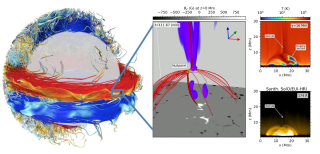
Using state-of-the-art magnetohydrodynamic simulation, the research team has demonstrated a compelling mechanism for nanojet formation. Their model shows that when two highly wound magnetic structures, known as magnetic flux ropes, coalesce, magnetic reconnection can occur at the interface between them. This explosive reconfiguration of magnetic fields releases energy and propels plasma outward from the reconnection site in the form of narrow (~100 km), high-speed (~100 km/s) jets with lengths on the order of a megameter (Mm), lasting for around 20 seconds.
“These nanojets are very small and short-lived, which makes them difficult to observe, and they likely occur in many more places across the solar corona than have been detected to date,” said Dr. Samrat Sen, the lead author of the study.
To address this challenge, the team generated synthetic observational signatures in extreme-ultraviolet (EUV) wavelengths for various solar telescopes such as the existing NASA’s Solar Dynamics Observatory (SDO), and upcoming Multi-slit Solar Explorer (MUSE) mission, based on their simulation. These results are published in the Astrophysical Journal Letters, which serve as predictive guides to help astronomers identify nanojets in observational data. By bridging the gap between theory and observation, this approach significantly increases the likelihood of detecting these elusive events in future campaigns.
Recent advances in solar instrumentation have already hinted at the existence of such fine-scale activity. High-resolution observations from multiple missions have revealed a wealth of small-scale dynamic phenomena in the Sun’s atmosphere. However, definitively identifying nanojets resulting from flux rope merging has remained a challenge until now.
What Comes Next?
These new findings come at a pivotal time. Next-generation space-based telescopes, including the MUSE, will be delivering unprecedented views of the Sun with the resolution needed to test these predictions. With the guidance provided by this study, scientists are now better equipped to search for nanojets and assess their contribution to coronal heating.
“This work opens a new avenue to unlock a new mechanism of the fine-scale dynamics in the Sun”. “By uncovering the role of magnetic flux rope interactions in generating nanojets, we are taking an important step toward understanding how the solar corona is heated, and, more broadly, how magnetic energy is released in astrophysical plasmas.” the lead author notes.
As new observations come in the future, scientists will be watching closely, whether, and to what extent these tiny sneezes of the Sun may hold the key to some of its biggest secrets of the coronal heating mystery.