
General
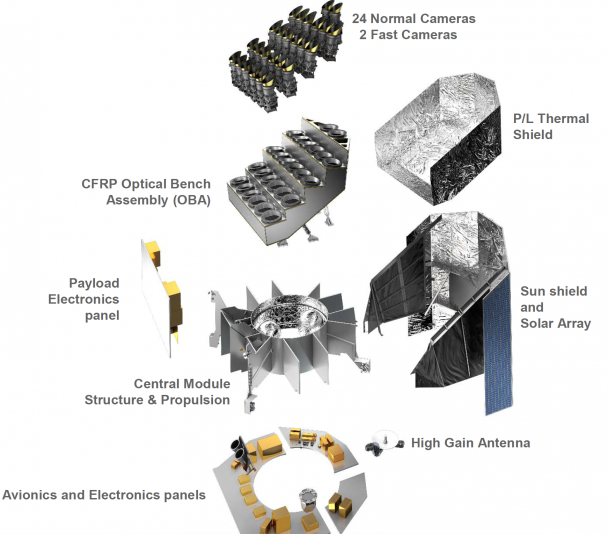
The PLATO (PLAnetary Transits and Oscillations of stars) mission is a space telescope developed by the European Space Agency (ESA), selected as ESA's M3 mission in 2014 as part of the Cosmic Vision 2015–2025 program, and is scheduled for launch in early 2027. Utilising an array of 26 individual cameras, its primary scientific goal is to discover and characterise Earth-sized exoplanets orbiting in the habitable zones of Sun-like stars. By monitoring the subtle dimming of stars as planets transit in front of them, PLATO will provide data on planetary masses, radii, and ages with unprecedented precision, helping scientists determine if these distant worlds could potentially support life and provide a new level on insight into exoplanet system structures and population statistics.
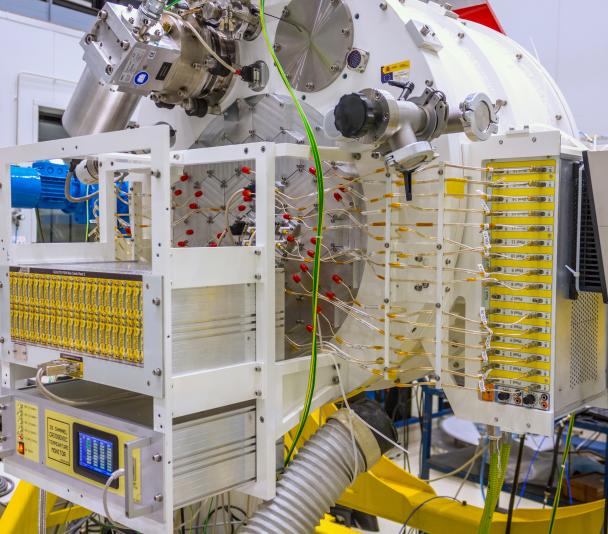
IAC's Instrumentation Division contributed to the misson with the Main Electronics Power Supply Unit (MEU-PSU), which is an intelligent power-supply for PLATO's Main Electronics Unit (MEU), in collaboration with the Instituto de Astrofísica de Andalucía (IAA). For MEU-PSU, we defined the performance of the equipment, consolidated the design, established the industrial activities needed for its production, and guided the unit through the final flight qualification approval in Fall 2024.
On the scientific side, IAC is contributing to PLATO with the preparations for the analysis of the light curves of the stars, to detect planets in the data returned by PLATO, with a focus on planets around eclipsing binaries and with a study of the stars using the technique of asteroseismology. In addition, we are preparing the ground based follow-up observations of candidates for exoplanets discovered by PLATO, for which a team at IAC prepares and coordinates the ground based photometric follow-up.
Members