
Bibcode
Raimundo, Sandra I.; Riffel, Rogerio; Li, Song-lin; Ramos Almeida, Cristina; Rembold, Sandro; Riffel, Rogemar A.; Storchi-Bergmann, Thaisa; Vestergaard, Marianne; Tous, José L.
Bibliographical reference
Monthly Notices of the Royal Astronomical Society
Advertised on:
9
2025
Citations
4
Refereed citations
4
Description
The process of active galactic nuclei (AGN) fuelling relies on the transport of gas across several orders of magnitude in physical scale until the gas reaches the supermassive black hole at the centre of a galaxy. This work explores the role of kinematically misaligned gas in the fuelling of AGN in a sample of 4769 local galaxies from the Mapping Nearby Galaxies at Apache Point Observatory (MaNGA) survey. We investigate for the first time the relative role of external interactions and the presence of kinematic misalignment as mechanisms to explain the observed increase in AGN fraction in galaxies with large stellar to gas kinematic misalignment (>45°). Using a sample of galaxies with evidence of recent external interactions we find that there is a significantly higher fraction of AGN in those where a large stellar to gas kinematic misalignment is observed (20$^{+6}_{-4}$ per cent) compared with 6.2$^{+0.6}_{-0.5}$ per cent in galaxies where no kinematic misalignment is observed. We determine that gas to stellar misalignment has an important role in the fraction of AGN observed, increasing the AGN fraction beyond the potential effect of external interactions. This result demonstrates the importance of misaligned structures to the fuelling of supermassive black holes.
Related projects
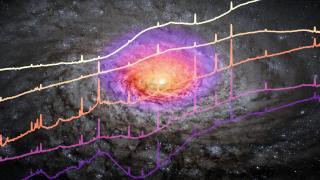
Nuclear Activity in Galaxies: a 3D Perspective from the Nucleus to the Outskirts
The group has two main research lines. First, the study of quasar-driven outflows in luminous and nearby obscured active galactic nuclei (AGN) and the impact that they have on their massive host galaxies (AGN feedback). As part of this project, QSOFEED (Quasar Feedback), we have obtained Gran Telescopio CANARIAS (GTC) infrared and optical
Cristina
Ramos Almeida