
Bibcode
Esparza-Arredondo, D.; Ramos Almeida, C.; Audibert, A.; Pereira-Santaella, M.; García-Bernete, I.; García-Burillo, S.; Shimizu, T.; Davies, R.; Hermosa Muñoz, L.; Alonso-Herrero, A.; Combes, F.; Speranza, G.; Zhang, L.; Campbell, S.; Bellocchi, E.; Bunker, A. J.; Díaz-Santos, T.; García-Lorenzo, B.; González-Martín, O.; Hicks, E. K. S.; Labiano, A.; Levenson, N. A.; Ricci, C.; Rosario, D.; Hoenig, S.; Packham, C.; Stalevski, M.; Fuller, L.; Izumi, T.; López-Rodríguez, E.; Rigopoulou, D.; Rouan, D.; Ward, M.
Bibliographical reference
Astronomy and Astrophysics
Advertised on:
1
2025
Journal
Citations
27
Refereed citations
24
Description
Understanding the processes that drive the morphology and kinematics of molecular gas in galaxies is crucial for comprehending star formation and, ultimately, galaxy evolution. Using data from the Galactic Activity, Torus and Outflow Survey (GATOS) obtained with the James Webb Space Telescope (JWST) and the archival data from the Atacama Large Millimeter/submillimeter Array (ALMA), we study the behavior of the warm molecular gas at temperatures of hundreds of Kelvin and the cold molecular gas at tens of Kelvin in the galaxy MCG‑05‑23‑16, which hosts an active galactic nucleus (AGN). Hubble Space Telescope (HST) images of this spheroidal galaxy, classified in the optical as S0, show a dust lane resembling a nuclear spiral and a surrounding ring. These features are also detected in CO(2‑1) and H2, and their morphologies and kinematics are consistent with rotation plus local inward gas motions along the kinematic minor axis in the presence of a nuclear bar. The H2 transitions 0-0 S(3), 0-0 S(4), and 0-0 S(5), which trace warmer and more excited gas, show more disrupted kinematics than 0-0 S(1) and 0-0 S(2), including clumps of high velocity dispersion (of up to ∼160 km s‑1), in regions devoid of CO(2‑1). The kinematics of one of these clumps, located ∼350 pc westward of the nucleus, are consistent with outflowing gas, possibly driven by localized star formation traced by polycyclic aromatic hydrocarbon emission at 11.3 μm. Overall, we observe a stratification of the molecular gas, with the colder gas located in the nuclear spiral, ring, and connecting arms, and most of the warmer gas with a higher velocity dispersion filling the inter-arm space. The compact jet, approximately 200 pc in size, detected with Very Large Array (VLA) observations, does not appear to significantly affect the distribution and kinematics of the molecular gas, possibly due to its limited intersection with the molecular gas disk.
Related projects
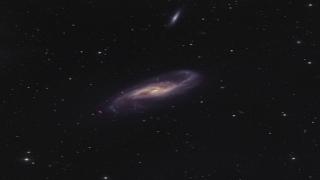
Spiral Galaxies: Evolution and Consequences
Our small group is well known and respected internationally for our innovative and important work on various aspects of the structure and evolution of nearby spiral galaxies. We primarily use observations at various wavelengths, exploiting synergies that allow us to answer the most pertinent questions relating to what the main properties of
Johan Hendrik
Knapen Koelstra
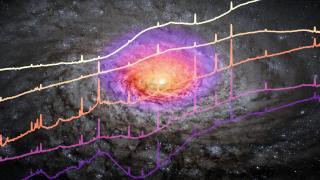
Nuclear Activity in Galaxies: a 3D Perspective from the Nucleus to the Outskirts
The group has two main research lines. First, the study of quasar-driven outflows in luminous and nearby obscured active galactic nuclei (AGN) and the impact that they have on their massive host galaxies (AGN feedback). As part of this project, QSOFEED (Quasar Feedback), we have obtained Gran Telescopio CANARIAS (GTC) infrared and optical
Cristina
Ramos Almeida