
Bibcode
Elbers, W.; Aviles, A.; Noriega, H. E.; Chebat, D.; Menegas, A.; Frenk, C. S.; Garcia-Quintero, C.; Gonzalez, D.; Ishak, M.; Lahav, O.; Naidoo, K.; Niz, G.; Yèche, C.; Abdul-Karim, M.; Ahlen, S.; Alves, O.; Andrade, U.; Armengaud, E.; Behera, J.; BenZvi, S.; Bianchi, D.; Brieden, S.; Brodzeller, A.; Brooks, D.; Burtin, E.; Calderon, R.; Canning, R.; Carnero Rosell, A.; Casas, L.; Castander, F. J.; Charles, M.; Chaussidon, E.; Chaves-Montero, J.; Claybaugh, T.; Cole, S.; Cooper, A. P.; Cuceu, A.; Dawson, K. S.; de la Macorra, A.; de Mattia, A.; Deiosso, N.; Dey, A.; Dey, B.; Ding, Z.; Doel, P.; Eisenstein, D. J.; Ferraro, S.; Font-Ribera, A.; Forero-Romero, J. E.; Garrison, L. H.; Gaztañaga, E.; Gil-Marín, H.; Gontcho, S. Gontcho A.; Gonzalez-Morales, A. X.; Gutierrez, G.; He, S.; Herbold, M.; Herrera-Alcantar, H. K.; Howlett, C.; Huterer, D.; Juneau, S.; Kehoe, R.; Kirkby, D.; Kisner, T.; Kremin, A.; Lamman, C.; Landriau, M.; Le Guillou, L.; Leauthaud, A.; Levi, M. E.; Li, Q.; Lodha, K.; Magneville, C.; Manera, M.; Martini, P.; Matthewson, W. L.; Meisner, A.; Mena-Fernández, J.; Miquel, R.; Moustakas, J.; Nadathur, S.; Newman, J. A.; Paillas, E.; Palanque-Delabrouille, N.; Percival, W. J.; Pieri, M. M.; Poppett, C.; Prada, F.; Pérez-Ràfols, I.; Rabinowitz, D.; Ramírez-Pérez, C.; Rashkovetskyi, M.; Ravoux, C.; Rivera-Morales, H.; Rohlf, J.; Ross, A. J.; Rossi, G.; Ruhlmann-Kleider, V.; Samushia, L.; Sanchez, E. et al.
Referencia bibliográfica
Physical Review D
Fecha de publicación:
10
2025
Revista
Número de citas
156
Número de citas referidas
116
Descripción
The Dark Energy Spectroscopic Instrument (DESI) Collaboration has obtained robust measurements of baryon acoustic oscillations in the redshift range 0.1<z<4.2, based on the Lyman-α forest and galaxies from data release 2. We combine these measurements with cosmic microwave background (CMB) data from Planck and the Atacama Cosmology Telescope to place our tightest constraints yet on the sum of neutrino masses. Assuming the cosmological ΛCDM model and three degenerate neutrino states, we find ∑mν<0.0642 eV (95%) with a marginalized error of σ(∑mν)=0.020 eV. We also constrain the effective number of neutrino species, finding Neff=3.23-0.34+0.35 (95%), in line with the Standard Model prediction. When accounting for neutrino oscillation constraints, we find a preference for the normal mass ordering and an upper limit on the lightest neutrino mass of ml<0.023 eV (95%). However, we determine using frequentist and Bayesian methods that our constraints are in tension with the lower limits derived from neutrino oscillations. Correcting for the physical boundary at zero mass, we report a 95% Feldman-Cousins upper limit of ∑mν<0.053 eV, breaching the lower limit from neutrino oscillations. Considering a more general Bayesian analysis with an effective cosmological neutrino mass parameter, ∑mν,eff, that allows for negative energy densities and removes unsatisfactory prior weight effects, we derive constraints that are in 3σ tension with the same oscillation limit, while the error rises to σ(∑mν,eff)=0.053 eV. In the absence of unknown systematics, this finding could be interpreted as a hint of new physics not necessarily related to neutrinos. The preference of DESI and CMB data for an evolving dark energy model offers one possible solution. In the w0waCDM model, we find ∑mν<0.163 eV (95%), relaxing the neutrino tension. These constraints all rely on the effects of neutrinos on the cosmic expansion history. Using full-shape power spectrum measurements of data release 1 galaxies, we place complementary constraints that rely on neutrino free streaming. Our strongest such limit in ΛCDM, using selected CMB priors, is ∑mν<0.193 eV (95%).
Proyectos relacionados
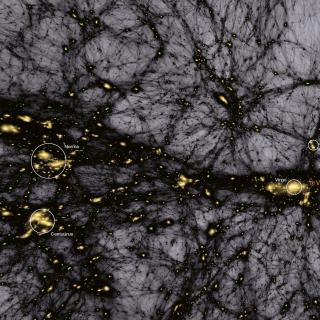
Cosmología con Trazadores de la Estructura a Gran Escala del Universo
El Fondo Cósmico de Microondas (FCM) contiene la información estadística de las semillas primigenias que han dado lugar a la formación de todas las estructuras en el Universo. Su contrapartida natural en el Universo local es la distribución de las galaxias que surgen como resultado del crecimiento gravitatorio de aquellas fluctuaciones de densidad
Francisco Shu
Kitaura Joyanes