
Bibcode
Mills, John; Spiniello, Chiara; Sergeyev, Alexey; Tortora, Crescenzo; Khramtsov, Vladyslav; D'Ago, Giuseppe; Maksymowicz-Maciata, Michalina; Benedetti, João P. V.; Ferré-Mateu, Anna; Cappellari, Michele; Davies, Roger; Hartke, Johanna; Rosen, Charles
Referencia bibliográfica
Monthly Notices of the Royal Astronomical Society
Fecha de publicación:
8
2025
Número de citas
2
Número de citas referidas
2
Descripción
This paper presents the first effort to Extend the Investigation of Stellar Populations In RElics (E-INSPIRE). We present a catalogue of 430 spectroscopically confirmed ultra-compact massive galaxies (UCMGs) from the Sloan Digital Sky Survey at redshifts $0.01< z< 0.3$. This increases the original INSPIRE sample eightfold, bridging the gap with the local Universe. For each object, we compute integrated stellar velocity dispersion, age, metallicity, and [Mg/Fe] through spectroscopic stellar population analysis. We infer star formation histories (SFHs), metallicity evolution histories (MEHs) and compute the Degree of Relicness (DoR) of each object. The UCMGs, covering a wide range of DoR from 0.05 to 0.88, can be divided into three groups, according to how extreme their SFH was. The first group consists of 81 extreme relics ($\text{DoR}\gtrsim 0.6$) that have formed the totality of their stellar mass by $z\sim 2$ and have super-solar metallicities at all cosmic epochs. The second group ($0.3\lesssim \text{DoR}\lesssim 0.6$) contains 293 objects also characterized by peaked SFHs but with a small percentage of later-formed stars and with a variety of MEHs. The third group ($\text{DoR}\lesssim 0.3$), has 56 objects that cannot be considered relics since they have extended SFHs and formed a non-negligible fraction (${>}25$ per cent) of their stellar mass at $z< 2$. We conclude that the most efficient method of finding relics is to select UCMGs with a combination of large velocity dispersion values (as already found by INSPIRE), super-solar metallicities and high [Mg/Fe].
Proyectos relacionados
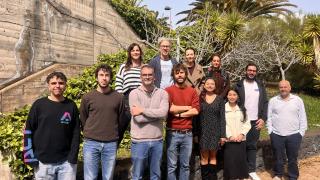
Huellas de la Formación de las Galaxias: Poblaciones estelares, Dinámica y Morfología
Bienvenida a la página web del g rupo de investigación Traces of Galaxy Formation. Somos un grupo de investigación amplio, diverso y muy activo cuyo objetivo principal es entender la formación de galaxias en el Universo de una manera lo más completa posible. Con el estudio detellado de las poblaciones estelares como bandera, estamos constantemente
Anna
Ferré Mateu