
Bibcode
van Dalen, Joyce N. D.; Levan, Andrew J.; Jonker, Peter G.; Malesani, Daniele Bjørn; Izzo, Luca; Sarin, Nikhil; Quirola-Vásquez, Jonathan; Mata Sánchez, Daniel; de Ugarte Postigo, Antonio; van Hoof, Agnes P. C.; Torres, Manuel A. P.; Schulze, Steve; Littlefair, Stuart P.; Chrimes, Ashley; Ravasio, Maria E.; Bauer, Franz E.; Martin-Carrillo, Antonio; Fraser, Morgan; van der Horst, Alexander J.; Jakobsson, Pall; O'Brien, Paul; De Pasquale, Massimiliano; Pugliese, Giovanna; Sollerman, Jesper; Tanvir, Nial R.; Zafar, Tayyaba; Anderson, Joseph P.; Galbany, Lluís; Gal-Yam, Avishay; Gromadzki, Mariusz; Müller-Bravo, Tomás E.; Ragosta, Fabio; Terwel, Jacco H.
Referencia bibliográfica
The Astrophysical Journal
Fecha de publicación:
4
2025
Revista
Número de citas
66
Número de citas referidas
57
Descripción
Detections of fast X-ray transients (FXTs) have accrued over the last few decades. However, their origin has remained mysterious. Rapid progress is now being made thanks to timely discoveries and localizations with the Einstein Probe mission. Early results indicate that FXTs may frequently, but not always, be associated with gamma-ray bursts (GRBs). Here, we report on the multiwavelength counterpart of FXT EP240414a, which has no reported gamma-ray counterpart. The transient is located 25.7 kpc in projection from a massive galaxy at z = 0.401. We perform comprehensive photometric and spectroscopic follow-up. The optical light curve shows at least three distinct emission episodes with timescales of ~1, 4, and 15 days and peak absolute magnitudes of MR ∼ ‑20, –21, and –19.5, respectively. The optical spectrum at early times is extremely blue, inconsistent with afterglow emission. It may arise from the interaction of both jet and supernova (SN) shock waves with the stellar envelope and a dense circumstellar medium, as has been suggested for some luminous fast blue optical transients (LFBOTs). At late times, the spectrum evolves to a broad-lined Type Ic SN, similar to those seen in collapsar long GRBs. This implies that the progenitor of EP240414a is a massive star creating a jet-forming SN inside a dense envelope, resulting in an X-ray outburst with a luminosity of ~1048 erg s‑1 and the complex observed optical/IR light curves. If correct, this argues for a causal link between the progenitors of long GRBs, FXTs, and LFBOTs.
Proyectos relacionados
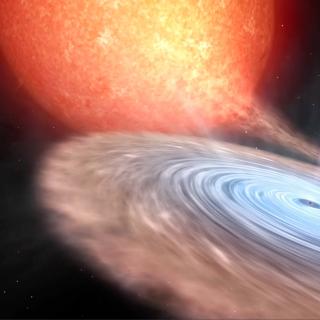
Agujeros negros, estrellas de neutrones, enanas blancas y su entorno local
Los agujeros negros y estrellas de neutrones en binarias de rayos-X son laboratorios únicos para explorar la física de estos objetos compactos. No solo permiten confirmar la existencia de agujeros negros de origen estelar a través de mediciones dinámicas de sus masas, sino que también permiten investigar el comportamiento de la materia y la
Montserrat
Armas Padilla