
Bibcode
Jiang, Shuai-Qing; Xu, Dong; van Hoof, Agnes P. C.; Lei, Wei-Hua; Liu, Yuan; Zhou, Hao; Chen, Yong; Fu, Shao-Yu; Yang, Jun; Liu, Xing; Zhu, Zi-Pei; Filippenko, Alexei V.; Jonker, Peter G.; Pozanenko, A. S.; Gao, He; Wu, Xue-Feng; Zhang, Bing; Lamb, Gavin P.; De Pasquale, Massimiliano; Kobayashi, Shiho; Bauer, Franz Erik; Sun, Hui; Pugliese, Giovanna; An, Jie; D'Elia, Valerio; Fynbo, Johan P. U.; Zheng, WeiKang; Castro-Tirado, Alberto J.; Yin, Yi-Han Iris; Zou, Yuan-Chuan; Deller, Adam T.; Pankov, N. S.; Volnova, A. A.; Moskvitin, A. S.; Spiridonova, O. I.; Oparin, D. V.; Rumyantsev, V.; Burkhonov, O. A.; Egamberdiyev, Sh. A.; Kim, V.; Krugov, M.; Tatarnikov, A. M.; Inasaridze, R.; Levan, Andrew J.; Malesani, Daniele Bjørn; Ravasio, Maria E.; Quirola-Vásquez, Jonathan; van Dalen, Joyce N. D.; Sánchez-Sierras, Javi; Mata Sánchez, Daniel; Littlefair, Stuart P.; Chacón, Jennifer A.; Torres, Manuel A. P.; Chrimes, Ashley A.; Sarin, Nikhil; Martin-Carrillo, Antonio; Dhillon, Vik; Yang, Yi; Brink, Thomas G.; Davies, Rebecca L.; Yang, Sheng; Aryan, Amar; Chen, Ting-Wan; Kong, Albert K. H.; Li, Wen-Xiong; Li, Rui-Zhi; Mao, Jirong; Pérez-García, Ignacio; Fernández-García, Emilio J.; Andrews, Moira; Farah, Joseph; Fan, Zhou; Padilla Gonzalez, Estefania; Howell, D. Andrew; Hartmann, Dieter; Hu, Jing-Wei; Jakobsson, Páll; Li, Cheng-Kui; Ling, Zhi-Xing; McCully, Curtis; Newsome, Megan; Schneider, Benjamin; Tinyanont, Kaew Samaporn; Sun, Ning-Chen; Terreran, Giacomo; Tang, Qing-Wen; Wang, Wen-Xin; Xu, Jing-Jing; Yuan, Wei-Min; Zhang, Bin-Bin; Zhao, Hai-Sheng; Zhang, Juan
Referencia bibliográfica
The Astrophysical Journal
Fecha de publicación:
7
2025
Revista
Número de citas
31
Número de citas referidas
25
Descripción
We present multiband observations and analysis of EP240801a, a low-energy, extremely soft gamma-ray burst (GRB) discovered on 2024 August 1 by the Einstein Probe (EP) satellite with a weak contemporaneous signal also detected by the Fermi Gamma-ray Burst Monitor (GBM). Optical spectroscopy of the afterglow, obtained by Gran Telescopio Canarias and Keck, identified the redshift of z = 1.6734. EP240801a exhibits a burst duration of 148 s in X-rays and 22.3 s in gamma rays, with X-rays leading by 80.61 s. Spectral lag analysis indicates that the gamma-ray signal arrived 8.3 s earlier than the X-rays. Joint spectral fitting of EP Wide-field X-ray Telescope and Fermi/GBM data yields an isotropic energy Eγ,iso=(5.57‑0.50+0.54)×1051erg , a peak energy Epeak=14.90‑4.71+7.08keV , and a fluence ratio S(25–50 keV)/S (50–100keV)=1.67‑0.46+0.74 , classifying EP240801a as an X-ray flash (XRF). The host-galaxy continuum spectrum, inferred using Prospector, was used to correct its contribution for the observed outburst optical data. Unusual early R-band behavior and EP Follow-up X-ray Telescope observations suggest multiple components in the afterglow. Three models are considered: a two-component jet model, a forward-reverse shock model, and a forward shock model with energy injection. All three provide reasonable explanations. The two-component jet model and the energy injection model imply a relatively small initial energy and velocity of the jet in the line of sight, while the forward-reverse shock model remains typical. Under the two-component jet model, EP240801a may resemble GRB 221009A (BOAT) if the bright narrow beam is viewed on-axis. Therefore, EP240801a can be interpreted as an off-beam (narrow) jet or an intrinsically weak GRB jet. Our findings provide crucial clues for uncovering the origin of XRFs.
Proyectos relacionados
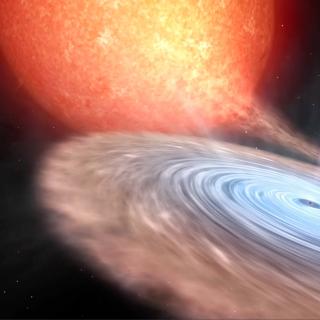
Agujeros negros, estrellas de neutrones, enanas blancas y su entorno local
Los agujeros negros y estrellas de neutrones en binarias de rayos-X son laboratorios únicos para explorar la física de estos objetos compactos. No solo permiten confirmar la existencia de agujeros negros de origen estelar a través de mediciones dinámicas de sus masas, sino que también permiten investigar el comportamiento de la materia y la
Montserrat
Armas Padilla