
Bibcode
Cuillandre, J. -C.; Bertin, E.; Bolzonella, M.; Bouy, H.; Gwyn, S.; Isani, S.; Kluge, M.; Lai, O.; Lançon, A.; Lang, D. A.; Laureijs, R.; Saifollahi, T.; Schirmer, M.; Stone, C.; Abdurro'uf; Aghanim, N.; Altieri, B.; Annibali, F.; Atek, H.; Awad, P.; Baes, M.; Bañados, E.; Barrado, D.; Belladitta, S.; Belokurov, V.; Boselli, A.; Bournaud, F.; Bovy, J.; Bowler, R. A. A.; Buenadicha, G.; Buitrago, F.; Cantiello, M.; Carollo, D.; Codis, S.; Collins, M. L. M.; Congedo, G.; Dalessandro, E.; de Lapparent, V.; De Paolis, F.; Diego, J. M.; Dimauro, P.; Dinis, J.; Dole, H.; Duc, P. -A.; Erkal, D.; Ezziati, M.; Ferguson, A. M. N.; Ferré-Mateu, A.; Franco, A.; Gavazzi, R.; George, K.; Gillard, W.; Golden-Marx, J. B.; Goldman, B.; Gonzalez, A. H.; Habas, R.; Hartley, W. G.; Hatch, N. A.; Kohley, R.; Hoar, J.; Howell, J. M.; Hunt, L. K.; Jablonka, P.; Jauzac, M.; Kang, Y.; Knapen, J. H.; Kneib, J. -P.; Kuzma, P. B.; Larsen, S. S.; Marchal, O.; Martín-Fleitas, J.; Marcos-Arenal, P.; Marleau, F. R.; Martín, E. L.; Massari, D.; McConnachie, A. W.; Meneghetti, M.; Miluzio, M.; Miro Carretero, J.; Miyatake, H.; Mondelin, M.; Montes, M.; Mora, A.; Müller, O.; Nally, C.; Noeske, K.; Nucita, A. A.; Oesch, P. A.; Oguri, M.; Peletier, R. F.; Poulain, M.; Quilley, L.; Racca, G. D.; Rejkuba, M.; Rhodes, J.; Rocci, P. -F.; Román, J.; Sacquegna, S.; Saremi, E.; Scaramella, R. et al.
Referencia bibliográfica
Astronomy and Astrophysics
Fecha de publicación:
5
2025
Revista
Número de citas
70
Número de citas referidas
64
Descripción
The Euclid Early Release Observations (ERO) showcase Euclid's capabilities in advance of its main mission by targeting 17 astronomical objects, including galaxy clusters, nearby galaxies, globular clusters, and star-forming regions. A total of 24 hours of observing time was allocated in the early months of operation, and the scientific community was engaged through an early public data release. We describe the development of the ERO pipeline to create visually compelling images while simultaneously meeting the scientific demands within months of launch by leveraging a pragmatic data-driven development strategy. The pipeline's key requirements are to preserve the image quality and to provide flux calibration and photometry for compact and extended sources. The pipeline's five pillars are removal of instrumental signatures, astrometric calibration, photometric calibration, image stacking, and the production of science-ready catalogues for both the VIS and NISP instruments. We report a point spread function (PSF) with a full width at half maximum of 0ʺ.16 in the optical IE-band and 0ʺ.49 in the near-infrared (NIR) bands YE, JE, and HE. Our VIS mean absolute flux calibration is accurate to about 1%, and the accuracy is 10% for NISP due to a limited calibration set; both instruments have considerable colour terms for individual sources. The median depth is 25.3 and 23.2 AB mag with a signal-to-noise ratio (S/N) of ten for galaxies, while it is 27.1 and 24.5 AB mag at an S/N of five for point sources for VIS and NISP, respectively. Euclid's ability to observe diffuse emission is exceptional due to its extended PSF nearly matching a pure diffraction halo, the best ever achieved by a wide-field high-resolution imaging telescope. Euclid offers unparalleled capabilities for exploring the low-surface brightness (LSB) Universe across all scales, providing high precision within a wide field of view (FoV), and opening a new observational window in the NIR. Median surface-brightness levels of 29.5 and 27.9, AB mag arcsec‑2 are achieved for VIS and NISP, respectively, for detecting a 10ʺ × 10ʺ extended feature at the 1 σ level. ★This paper is published on behalf of the Euclid Consortium.
Proyectos relacionados
Huellas de la Formación de las Galaxias: Poblaciones estelares, Dinámica y Morfología
Bienvenida a la página web del g rupo de investigación Traces of Galaxy Formation. Somos un grupo de investigación amplio, diverso y muy activo cuyo objetivo principal es entender la formación de galaxias en el Universo de una manera lo más completa posible. Con el estudio detellado de las poblaciones estelares como bandera, estamos constantemente
Anna
Ferré Mateu
Las Galaxias Espirales: Evolución y Consecuencias
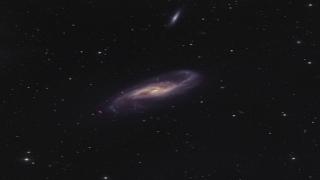
Nuestro grupo pequeño esta bien conocido y respetado internacionalmente por nuestro trabajo inovativo e importante en varios aspectos de la estructura y la evolución de las galaxias espirales cercanas. Usamos principalmente observaciones en varias longitudes de onda, explotando las sinergías que nos permiten responder a las cuestiones más
Johan Hendrik
Knapen Koelstra