
Bibcode
Stefanov, A. K.; Suárez Mascareño, A.; González Hernández, J. I.; Nari, N.; Rebolo, R.; Affer, L.; Micela, G.; Ribas, I.; Sozzetti, A.; Perger, M.; Pinamonti, M.; Damasso, M.; Maldonado, J.; González Álvarez, E.; Scandariato, G.
Referencia bibliográfica
Astronomy and Astrophysics
Fecha de publicación:
3
2025
Revista
Número de citas
4
Número de citas referidas
4
Descripción
The low masses of M dwarfs create attractive opportunities for exoplanet radial-velocity (RV) detections. These stars, however, exhibit strong stellar activity that may attenuate or mimic planetary signals. We present a velocimetric analysis of one such M dwarf, GJ 3998 (d = 18.2 pc), with two published short-period super-Earths: GJ 3998 b and GJ 3998 c. We use additional data from the HARPS-N spectrograph to confirm these two planets and to look for more. We carry out joint modelling of: (i) RV planetary signals, (ii) stellar rotation in RV and activity indicators through Gaussian processes, and (iii) long-term trends in RV and activity indicators. We constrain the rotational period of GJ 3998 to Prot = 30.2 ± 0.3 d and discover long-term sinusoidal imprints in RV and the full width at half maximum with a period of Pcyc = 316‑8+14 d. We confirm GJ 3998 b and GJ 3998 c, and detect a third planet: GJ 3998 d, whose signal had previously been attributed to stellar activity. GJ 3998 d has an orbital period of 41.78 ± 0.05 d, a minimum mass of 6.07‑0.96+1.00 M⊕, and a mean insolation flux of 1.2‑0.2+0.3 Φ⊕. This makes it one of the few known planets receiving an Earth-like insolation flux.
Proyectos relacionados
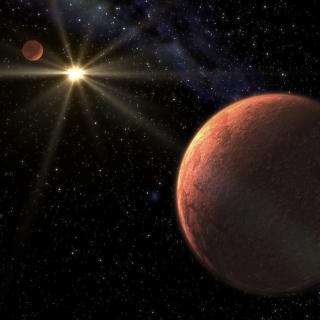
Estrellas de Baja Masa, Enanas Marrones y Planetas
Se investigan los procesos que conducen a la formación de estrellas de baja masa, enanas marrones y exoplanetas y caracterizar las propiedades físicas de estos astros en varias etapas evolutivas. Las estrellas de muy baja masa y las enanas marrones son probablemente los objetos más numerosos de nuestra Galaxia, pero no por ello están
Rafael
Rebolo López