
Bibcode
Thakore, B.; Negro, M.; Regis, M.; Camera, S.; Gruen, D.; Fornengo, N.; Roodman, A.; Porredon, A.; Schutt, T.; Cuoco, A.; Alarcon, A.; Amon, A.; Bechtol, K.; Becker, M. R.; Bernstein, G. M.; Campos, A.; Carnero Rosell, A.; Carrasco Kind, M.; Cawthon, R.; Chang, C.; Chen, R.; Choi, A.; Cordero, J.; Davis, C.; DeRose, J.; Diehl, H. T.; Dodelson, S.; Doux, C.; Drlica-Wagner, A.; Eckert, K.; Elvin-Poole, J.; Everett, S.; Ferté, A.; Gatti, M.; Giannini, G.; Gruendl, R. A.; Harrison, I.; Hartley, W. G.; Huff, E. M.; Jarvis, M.; Kuropatkin, N.; Leget, P. -F.; MacCrann, N.; McCullough, J.; Myles, J.; Navarro-Alsina, A.; Pandey, S.; Prat, J.; Raveri, M.; Rollins, R. P.; Ross, A. J.; Rykoff, E. S.; Sánchez, C.; Secco, L. F.; Sevilla-Noarbe, I.; Sheldon, E.; Shin, T.; Troxel, M. A.; Tutusaus, I.; Yanny, B.; Yin, B.; Zhang, Y.; Aguena, M.; Brooks, D.; Carretero, J.; da Costa, L. N.; Davis, T. M.; De Vicente, J.; Desai, S.; Doel, P.; Flaugher, B.; Frieman, J.; García-Bellido, J.; Gaztanaga, E.; Gutierrez, G.; Hinton, S. R.; Hollowood, D. L.; Honscheid, K.; James, D. J.; Kuehn, K.; Lahav, O.; Lee, S.; Lima, M.; Marshall, J. L.; Mena-Fernández, J.; Miquel, R.; Ogando, R. L. C.; Palmese, A.; Pieres, A.; Plazas Malagón, A. A.; Samuroff, S.; Sanchez, E.; Sanchez Cid, D.; Smith, M.; Suchyta, E.; Tarle, G.; Vikram, V.; Walker, A. R.; Weaverdyck, N.
Referencia bibliográfica
Journal of Cosmology and Astroparticle Physics
Fecha de publicación:
6
2025
Número de citas
4
Número de citas referidas
4
Descripción
Our understanding of the γ-ray sky has improved dramatically in the past decade, however, the unresolved γ-ray background (UGRB) still has a potential wealth of information about the faintest γ-ray sources pervading the Universe. Statistical cross-correlations with tracers of cosmic structure can indirectly identify the populations that most characterize the γ-ray background. In this study, we analyze the angular correlation between the γ-ray background and the matter distribution in the Universe as traced by gravitational lensing, leveraging more than a decade of observations from the Fermi-Large Area Telescope (LAT) and 3 years of data from the Dark Energy Survey (DES). We detect a correlation at signal-to-noise ratio of 8.9. Most of the statistical significance comes from large scales, demonstrating, for the first time, that a substantial portion of the UGRB aligns with the mass clustering of the Universe as traced by weak lensing. Blazars provide a plausible explanation for this signal, especially if those contributing to the correlation reside in halos of large mass (∼ 1014 M ⊙) and account for approximately 30–40% of the UGRB above 10 GeV. Additionally, we observe a preference for a curved γ-ray energy spectrum, with a log-parabolic shape being favored over a power-law. We also discuss the possibility of modifications to the blazar model and the inclusion of additional γ-ray sources, such as star-forming galaxies, misalinged active galactic nuclei, or particle dark matter.
Proyectos relacionados
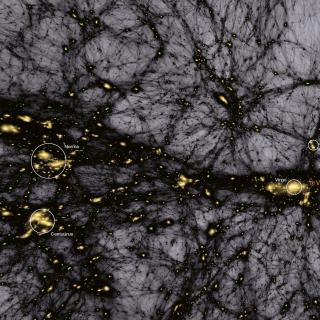
Cosmología con Trazadores de la Estructura a Gran Escala del Universo
El Fondo Cósmico de Microondas (FCM) contiene la información estadística de las semillas primigenias que han dado lugar a la formación de todas las estructuras en el Universo. Su contrapartida natural en el Universo local es la distribución de las galaxias que surgen como resultado del crecimiento gravitatorio de aquellas fluctuaciones de densidad
Francisco Shu
Kitaura Joyanes