
Bibcode
Hernández-Monteagudo, Carlos; Aricò, G.; Chaves-Montero, J.; Abramo, L. R.; Arnalte-Mur, P.; Hernán-Caballero, A.; Galindo-Guil, Francisco José; López-Sanjuan, C.; Marra, V.; von Marttens, R.; Tempel, E.; Cenarro, J.; Cristóbal-Hornillos, D.; Marín-Franch, A.; Moles, M.; Varela, J.; Ramió, H. Vázquez; Alcaniz, J.; Dupke, R.; Ederoclite, A.; , L. Sodré, Jr.; Angulo, R. E.
Referencia bibliográfica
The Open Journal of Astrophysics
Fecha de publicación:
7
2025
Número de citas
0
Número de citas referidas
0
Descripción
Observational and/or astrophysical systematics modulating the observed number of luminous tracers can constitute a major limitation in the cosmological exploitation of surveys of the large scale structure of the universe. Part of this limitation arises on top of our ignorance on how such systematics actually impact the observed galaxy/quasar fields. In this work we develop a generic, hybrid model for an arbitrary number of systematics that may modulate observations in both an additive and a multiplicative way, after applying a nonlinear power law transformation. This model allows us devising a novel algorithm that addresses the identification and correction for either additive and/or multiplicative contaminants. We test this model on galaxy mocks and systematics templates inspired from data of the third data release of the Javalambre Photometric Local Universe Survey (J-PLUS). We find that our method clearly outperforms standard methods that assume either an additive or multiplicative character for all contaminants in scenarios where both characters are actually acting on the observed data. In simpler scenarios where only an additive or multiplicative imprint on observations is considered, our hybrid method does not lie far behind the corresponding simplified, additive/multiplicative methods. Nonetheless, in scenarios of mild/low impact of systematics, we find that our hybrid approach converges towards the standard method that assumes additive contamination, as predicted by our model describing systematics. Our methodology also allows for the estimation of biases induced by systematics residuals on different angular scales and under different observational configurations, although these predictions necessarily restrict to the subset of known/identified potential systematics, and say nothing about ``unknown unknowns" possibly impacting the data.
Proyectos relacionados
Cosmología con Trazadores de la Estructura a Gran Escala del Universo
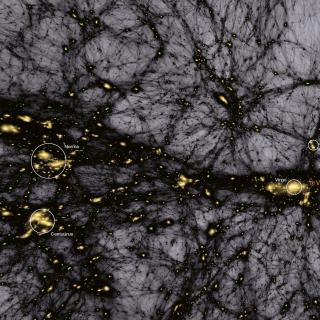
El Fondo Cósmico de Microondas (FCM) contiene la información estadística de las semillas primigenias que han dado lugar a la formación de todas las estructuras en el Universo. Su contrapartida natural en el Universo local es la distribución de las galaxias que surgen como resultado del crecimiento gravitatorio de aquellas fluctuaciones de densidad
Francisco Shu
Kitaura Joyanes