
Bibcode
Herard-Demanche, Thomas; Bouwens, Rychard J.; Oesch, Pascal A.; Naidu, Rohan P.; Decarli, Roberto; Nelson, Erica J.; Brammer, Gabriel; Weibel, Andrea; Xiao, Mengyuan; Stefanon, Mauro; Walter, Fabian; Matthee, Jorryt; Meyer, Romain A.; Wuyts, Stijn; Reddy, Naveen; Rowland, Lucie; van Leeuwen, Ivana; Haro, Pablo Arrabal; Dannerbauer, Helmut; Shapley, Alice E.; Chisholm, John; van Dokkum, Pieter; Labbe, Ivo; Illingworth, Garth; Schaerer, Daniel; Shivaei, Irene
Referencia bibliográfica
Monthly Notices of the Royal Astronomical Society
Fecha de publicación:
2
2025
Número de citas
50
Número de citas referidas
42
Descripción
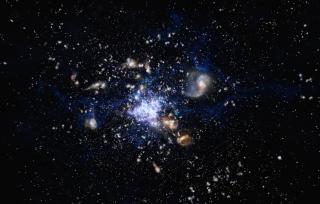
We report the detection of a 13$\sigma$ H$\alpha$ emission line from HDF850.1 at $z=5.188\pm 0.001$ using the FRESCO (First Reionization Era Spectroscopically Complete Observations) NIRCam F444W grism observations. Detection of H$\alpha$ in HDF850.1 is noteworthy, given its high far-infrared (IR) luminosity, substantial dust obscuration, and the historical challenges in deriving its redshift. HDF850.1 shows a clear detection in the F444W imaging data, distributed between a northern and southern component, mirroring that seen in [C II] from the Plateau de Bure Interferometer. Modelling the spectral energy distribution of each component separately, we find that the northern component has a higher mass, star formation rate (SFR), and dust extinction than the southern component. The observed H$\alpha$ emission appears to arise entirely from the less-obscured southern component and shows a similar $\Delta$v$\sim$ + 130 ${\rm{km\,s}}^{-1}$ velocity offset to that seen for [C II] relative to the source systemic redshift. Leveraging H$\alpha$-derived redshifts from FRESCO observations, we find that HDF850.1 is forming in one of the richest environments identified to date at $z\gt 5$, with 100 $z=5.17$-5.20 galaxies distributed across 13 smaller structures and a $\sim$(15 cMpc)$^3$ volume. Based on the evolution of analogous structures in cosmological simulations, the $z=5.17$-5.20 structures seem likely to collapse into a single $\gt 10^{14}$${\rm M}_{\odot }$ cluster by $z\sim 0$. Comparing galaxy properties forming within this overdensity with those outside, we find the masses, SFRs, and $UV$ luminosities inside the overdensity to be clearly higher. The prominence of H$\alpha$ line emission from HDF850.1 and other known highly obscured $z\gt 5$ galaxies illustrates the potential of NIRCam-grism programs to map both the early build-up of IR-luminous galaxies and overdense structures.
Proyectos relacionados
Gas Molecular y Polvo en Galacias através del Tiempo Cósmico
Dos cuestiones fundamentales en la Astrofísica son la conversión de gas molecuar en estrellas y cómo este proceso físico depende del entorno en todas las escalas, desde sistemas planetarios, cúmulos estelares, galaxias hasta cúmulos de galaxias. El objectivo principal de este proyecto es el de estudiar la formación y evolución de galaxias a partir
Helmut
Dannerbauer