
Bibcode
Bocquet, S.; Grandis, S.; Krause, E.; To, C.; Bleem, L. E.; Klein, M.; Mohr, J. J.; Schrabback, T.; Alarcon, A.; Alves, O.; Amon, A.; Andrade-Oliveira, F.; Baxter, E. J.; Bechtol, K.; Becker, M. R.; Bernstein, G. M.; Blazek, J.; Camacho, H.; Campos, A.; Carnero Rosell, A.; Carrasco Kind, M.; Cawthon, R.; Chang, C.; Chen, R.; Choi, A.; Cordero, J.; Crocce, M.; Davis, C.; DeRose, J.; Diehl, H. T.; Dodelson, S.; Doux, C.; Drlica-Wagner, A.; Eckert, K.; Eifler, T. F.; Elsner, F.; Elvin-Poole, J.; Everett, S.; Fang, X.; Ferté, A.; Fosalba, P.; Friedrich, O.; Frieman, J.; Gatti, M.; Giannini, G.; Gruen, D.; Gruendl, R. A.; Harrison, I.; Hartley, W. G.; Herner, K.; Huang, H.; Huff, E. M.; Huterer, D.; Jarvis, M.; Kuropatkin, N.; Leget, P. -F.; Lemos, P.; Liddle, A. R.; MacCrann, N.; McCullough, J.; Muir, J.; Myles, J.; Navarro-Alsina, A.; Pandey, S.; Park, Y.; Porredon, A.; Prat, J.; Raveri, M.; Rollins, R. P.; Roodman, A.; Rosenfeld, R.; Rykoff, E. S.; Sánchez, C.; Sanchez, J.; Secco, L. F.; Sevilla-Noarbe, I.; Sheldon, E.; Shin, T.; Troxel, M. A.; Tutusaus, I.; Varga, T. N.; Weaverdyck, N.; Wechsler, R. H.; Wu, H. -Y.; Yanny, B.; Yin, B.; Zhang, Y.; Zuntz, J.; Abbott, T. M. C.; Ade, P. A. R.; Aguena, M.; Allam, S.; Allen, S. W.; Anderson, A. J.; Ansarinejad, B.; Austermann, J. E.; Bayliss, M.; Beall, J. A.; Bender, A. N.; Benson, B. A. et al.
Referencia bibliográfica
Physical Review D
Fecha de publicación:
3
2025
Revista
Número de citas
16
Número de citas referidas
12
Descripción
Cosmic shear, galaxy clustering, and the abundance of massive halos each probe the large-scale structure of the Universe in complementary ways. We present cosmological constraints from the joint analysis of the three probes, building on the latest analyses of the lensing-informed abundance of clusters identified by the South Pole Telescope (SPT) and of the auto- and cross-correlation of galaxy position and weak lensing measurements (3×2pt) in the Dark Energy Survey (DES). We consider the cosmological correlation between the different tracers and we account for the systematic uncertainties that are shared between the large-scale lensing correlation functions and the small-scale lensing-based cluster mass calibration. Marginalized over the remaining Λ cold dark matter (ΛCDM) parameters (including the sum of neutrino masses) and 52 astrophysical modeling parameters, we measure Ωm=0.300±0.017 and σ8=0.797±0.026. Compared to constraints from Planck primary cosmic microwave background (CMB) anisotropies, our constraints are only 15% wider with a probability to exceed of 0.22 (1.2σ) for the two-parameter difference. We further obtain S8≡σ8(Ωm/0.3)0.5=0.796±0.013 which is lower than the Planck measurement at the 1.6σ level. The combined SPT cluster, DES 3×2pt, and Planck datasets mildly prefer a nonzero positive neutrino mass, with a 95% upper limit ∑mν<0.25 eV on the sum of neutrino masses. Assuming a wCDM model, we constrain the dark energy equation of state parameter w=-1.15-0.17+0.23 and when combining with Planck primary CMB anisotropies, we recover w=-1.20-0.09+0.15, a 1.7σ difference with a cosmological constant. The precision of our results highlights the benefits of multiwavelength multiprobe cosmology and our analysis paves the way for upcoming joint analyses of next-generation datasets.
Proyectos relacionados
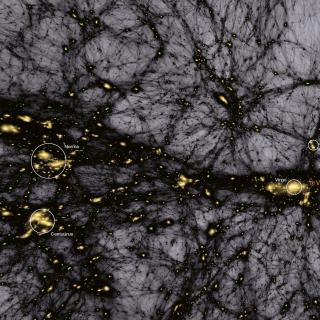
Cosmología con Trazadores de la Estructura a Gran Escala del Universo
El Fondo Cósmico de Microondas (FCM) contiene la información estadística de las semillas primigenias que han dado lugar a la formación de todas las estructuras en el Universo. Su contrapartida natural en el Universo local es la distribución de las galaxias que surgen como resultado del crecimiento gravitatorio de aquellas fluctuaciones de densidad
Francisco Shu
Kitaura Joyanes