
Bibcode
Bidaran, Bahar; Pérez, Isabel; Sánchez-Menguiano, Laura; Argudo-Fernández, María; Ferré-Mateu, Anna; Navarro, Julio F.; Peletier, Reynier F.; Ruiz-Lara, Tomás; van de Ven, Glenn; Verley, Simon; Zurita, Almudena; Duarte Puertas, Salvador; Falcón-Barroso, Jesús; Sánchez-Blázquez, Patricia; Jiménez, Andoni
Referencia bibliográfica
Astronomy and Astrophysics
Fecha de publicación:
1
2025
Revista
Número de citas
13
Número de citas referidas
12
Descripción
We report, for the first time, the detection of a sample of quenched and isolated dwarf galaxies (with 8.9 < log(M⋆/M⊙) < 9.5) in the least dense regions of the cosmic web, including voids, filaments, and walls. These dwarfs have no neighboring galaxy within 1.0 Mpc in projected distance. Based on the full spectral fitting of their central spectra using Sloan Digital Sky Survey data, these galaxies are gas-deprived, while also exhibiting a stellar mass assembly very similar to dwarfs in the central regions of galaxy clusters. Furthermore, they have experienced no significant star formation in the past 2 Gyr. Additionally, analyses of r-band images from the Dark Energy Camera Legacy Survey have shown that these dwarf galaxies host a central nuclear star cluster (NSC). Detecting quenched, isolated dwarf galaxies in cosmic voids indicates that environmental factors are not the sole drivers of their quenching. Internal mechanisms, such as feedback from in situ star formation, which also contribute to the NSC formation, along with black holes or variations in the conditions around their formation, offer potential explanations for star formation suppression in these galaxies. These findings highlight the need for a significant revision in our understanding of baryonic physics, particularly concerning the formation and evolution of low-mass galaxies.
Proyectos relacionados
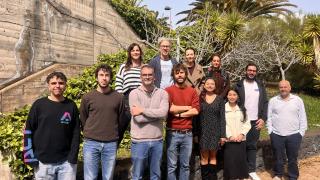
Huellas de la Formación de las Galaxias: Poblaciones estelares, Dinámica y Morfología
Bienvenida a la página web del g rupo de investigación Traces of Galaxy Formation. Somos un grupo de investigación amplio, diverso y muy activo cuyo objetivo principal es entender la formación de galaxias en el Universo de una manera lo más completa posible. Con el estudio detellado de las poblaciones estelares como bandera, estamos constantemente
Anna
Ferré Mateu