
Bibcode
Ambrifi, A.; Mata Sánchez, D.; Muñoz-Darias, T.; Sánchez-Sierras, J.; Armas Padilla, M.; Baglio, M. C.; Casares, J.; Corral-Santana, J. M.; Cúneo, V. A.; Fender, R. P.; Ponti, G.; Russell, D. M.; Shidatsu, M.; Steeghs, D.; Torres, M. A. P.; Ueda, Y.; Vincentelli, F.
Referencia bibliográfica
Astronomy and Astrophysics
Fecha de publicación:
2
2025
Revista
Número de citas
6
Número de citas referidas
4
Descripción
GX 339–4 is one of the prototypical black hole X-ray transients, exhibiting recurrent outbursts that allow detailed studies of black hole accretion and ejection phenomena. In this work we present four epochs of optical and near-infrared spectroscopy obtained with X-shooter at the Very Large Telescope. The dataset includes two hard state spectra, collected during the 2013 and 2015 outbursts, and two soft state spectra observed during the 2021 outburst. Strong Balmer, Paschen, He I and He II emission lines are consistently observed in all spectra, while Brackett transitions and the Bowen blend are only prominent in the soft state. Although P-Cygni profiles are not identified, the presence of wind signatures, such as extended emission wings, flat-top and asymmetric red-skewed profiles, is consistently observed through most emission lines, suggesting the presence of wind-type ejecta. These features are particularly evident in the hard state, but they are also observed in the soft state, especially in the near-infrared. This strengthens the case for state-independent winds in black hole transients and increases the evidence for wind signatures in low-to-intermediate orbital inclination systems. We also study the spectral energy distribution, which provides evidence for the presence of synchrotron emission during the hard state. The jet significantly affects the near-infrared continuum, greatly diluting the emission features produced in the accretion flow. The simultaneous identification of both jet and wind signatures during the hard state reinforces the idea of a complex outflow scenario, in which different types of ejecta coexist.
Proyectos relacionados
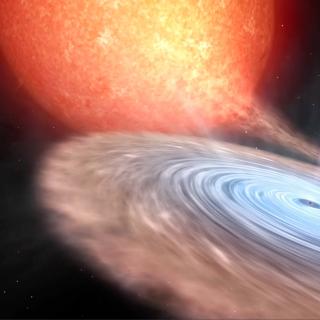
Agujeros negros, estrellas de neutrones, enanas blancas y su entorno local
Los agujeros negros y estrellas de neutrones en binarias de rayos-X son laboratorios únicos para explorar la física de estos objetos compactos. No solo permiten confirmar la existencia de agujeros negros de origen estelar a través de mediciones dinámicas de sus masas, sino que también permiten investigar el comportamiento de la materia y la
Montserrat
Armas Padilla