
Bibcode
Dominguez-Tagle, C.; Žerjal, M.; Sedighi, N.; Mas-Buitrago, P.; Martin, E. L.; Zhang, J. -Y.; Vitas, N.; Béjar, V. J. S.; Tsilia, S.; Muñoz Torres, S.; Lodieu, N.; Barrado, D.; Solano, E.; Cruz, P.; Tata, R.; Phan-Bao, N.; Burgasser, A.
Referencia bibliográfica
The Astrophysical Journal
Fecha de publicación:
9
2025
Revista
Número de citas
11
Número de citas referidas
11
Descripción
The Near-Infrared Spectrometer and Photometer on board the Euclid space mission has obtained near-infrared (NIR) slitless spectra of millions of objects, including hundreds of ultracool dwarfs (UCDs). Euclid observations retrieve images and spectra simultaneously. This observing mode marks a new era in the discovery of new objects, such as L- and T-type dwarfs, which can be found from direct identification through the H2O and CH4 absorption bands. NISP spectral resolution (R ∼ 450) is enough to classify the objects by the spectral type using known standard templates. Q1 provided more than 4 million NIR spectra in one visit to the Euclid Deep Fields. The large amount of spectra released in these fields allowed us to (a) confirm the UCD nature of almost half of the photometric candidates compiled by J. Y. Zhang et al.; (b) discover at least 11 new late L- and T-type dwarfs by a specific spectral index search in Q1 data; and (c) spectroscopically confirm 100 more candidates from a new photometric selection conducted by M. Žerjal et al. We present a preliminary list of Euclid UCD templates built by the combination of the best spectra from all these searches. We include the first spectral analysis of confirmed UCDs from Q1 data; spectral classifications; determination of effective temperatures; H2O, CH4, and NH3 spectral indices; and measurements of the K I absorption doublet. This paper is a first step in the study of Euclid UCDs and will be improved with each subsequent data release.
Proyectos relacionados
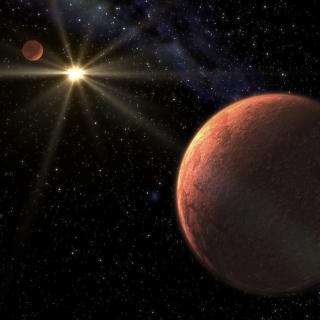
Estrellas de Baja Masa, Enanas Marrones y Planetas
Se investigan los procesos que conducen a la formación de estrellas de baja masa, enanas marrones y exoplanetas y caracterizar las propiedades físicas de estos astros en varias etapas evolutivas. Las estrellas de muy baja masa y las enanas marrones son probablemente los objetos más numerosos de nuestra Galaxia, pero no por ello están
Rafael
Rebolo López

Exoplanetas y Astrobiología
La búsqueda de vida en el Universo se ha visto impulsada por los recientes descubrimientos de planetas alrededor de otras estrellas (los llamados exoplanetas), convirtiéndose en uno de los campos más activos dentro de la Astrofísica moderna. En los últimos años los descubrimientos cada vez más numerosos de nuevos exoplanetas y los últimos avances
Enric
Pallé Bago