
Bibcode
Serra-Ricart, M.; Licandro, J.; Alarcon, M. R.
Referencia bibliográfica
Astronomy and Astrophysics
Fecha de publicación:
12
2025
Revista
Número de citas
0
Número de citas referidas
0
Descripción
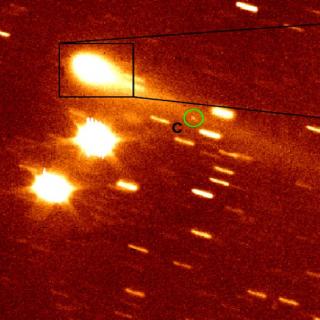
Aims. We investigate the pre-perihelion rotational parameters of the nucleus of 3I/ATLAS modeling jet structures observed in the inner coma. Methods. The comet was extensively monitored on 37 nights between 2025, July 2 and September 5, using the imaging capabilities of the Two-meter Twin Telescope (TTT) at the Teide Observatory (Tenerife, Canary Islands, Spain). To enhance the visibility of potential fine-scale structures in the inner coma of 3I/ATLAS, a Laplacian-filtering technique was applied to the reduced and combined images. Results. We present observations of the detection of a faint high-latitude jet in the inner coma of comet 3I/ATLAS that coincides with the broad plume detected in visible images along PA 280 ± 10°. A detailed analysis shows that the jet was clearly detected on seven nights (2025, August 3, 5, 18, 19, 21, 24, and 29). The jet maintains an almost, though not perfectly, constant position angle (PA) throughout these epochs. High-precision PA measurements at a projected distance of 6000 km from the cometary optocenter reveal a periodic modulation centered at ∼280°, consistent with a high-latitude jet undergoing precessional motion around the sky-projected spin axis of the nucleus. This is the first periodic jet-angle modulation detected in an interstellar comet. The derived periodicity of 7.74 ± 0.35 h may imply a nucleus rotation period of Prot = 15.48 ± 0.70 h if the jet originates from a single active source near one of the poles. This value is slightly shorter than the period of Prot = 16.79 ± 0.23 h derived from the photometric time series. From the measured PA range, the sky-projected orientation of the spin axis is derived as PA = 280.7 ± 0.2°. ★ Based on observations made with the Two-meter Twin Telescope (TTT).
Proyectos relacionados
Pequeños Cuerpos del Sistema Solar
Este Proyecto estudia las propiedades físicas y composicionales de los llamados pequeños cuerpos del Sistema Solar, que incluyen asteroides, objetos helados y cometas. Entre los grupos de mayor interés destacan los objetos trans-neptunianos (TNOs), incluyendo los objetos más lejanos detectados hasta la fecha (Extreme-TNOs o ETNOs); los cometas, y
Julia de
León Cruz