
Bibcode
Faherty, Jacqueline K.; Meisner, Aaron M.; Burningham, Ben; Visscher, Channon; Line, Michael; Suárez, Genaro; Gagné, Jonathan; Alejandro Merchan, Sherelyn; Rothermich, Austin James; Burgasser, Adam J.; Schneider, Adam C.; Caselden, Dan; Kirkpatrick, J. Davy; Kuchner, Marc Jason; Bardalez Gagliuffi, Daniella Carolina; Eisenhardt, Peter; Gelino, Christopher R.; Gonzales, Eileen C.; Marocco, Federico; Leggett, Sandy; Lodieu, Nicolas; Casewell, Sarah L.; Tremblin, Pascal; Cushing, Michael; Zapatero Osorio, Maria Rosa; Béjar, Víctor J. S.; Gauza, Bartosz; Wright, Edward; Phillips, Mark W.; Zhang, Jun-Yan; Martin, Eduardo L.
Referencia bibliográfica
Nature
Fecha de publicación:
9
2025
Revista
Número de citas
17
Número de citas referidas
15
Descripción
Within 20 pc of the Sun, there are currently 29 known cold brown dwarfs—sources with measured distances and an estimated effective temperature between that of Jupiter (170 K) and approximately 500 K (ref. 1). These sources are almost all isolated and are the closest laboratories we have for detailed atmospheric studies of giant planets formed outside the Solar System. Here we report JWST observations of one such source, WISEA J153429.75-104303.3 (W1534), which we confirm is a substellar mass member of the Galactic halo with a metallicity of less than 0.01 times solar. Its spectrum reveals methane (CH4), water (H2O) and silane (SiH4) gas. Although SiH4 is expected to serve as a key reservoir for the cloud-forming element Si in gas giant worlds, it has remained undetected until now because it is removed from observable atmospheres by the formation of silicate clouds at depth. These condensates are favoured with increasing metallicity, explaining why SiH4 remains undetected on well-studied metal-rich Solar System worlds such as Jupiter and Saturn2. On the metal-poor world W1534, we detect a clear signature of SiH4 centred at about 4.55 μm with an abundance of 19 ± 2 parts per billion. Our chemical modelling suggests that this SiH4 abundance may be quenched at approximately kilobar levels just above the silicate cloud layers, in which vertical atmospheric mixing can transport SiH4 to the observable photosphere. The formation and detection of SiH4 demonstrates key coupled relationships between composition, cloud formation and atmospheric mixing in cold brown dwarf and planetary atmospheres.
Proyectos relacionados
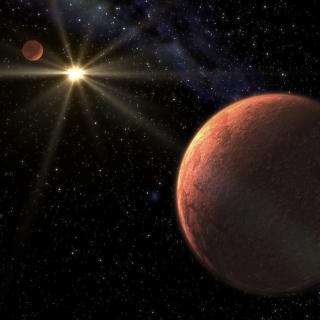
Estrellas de Baja Masa, Enanas Marrones y Planetas
Se investigan los procesos que conducen a la formación de estrellas de baja masa, enanas marrones y exoplanetas y caracterizar las propiedades físicas de estos astros en varias etapas evolutivas. Las estrellas de muy baja masa y las enanas marrones son probablemente los objetos más numerosos de nuestra Galaxia, pero no por ello están
Rafael
Rebolo López

Exoplanetas y Astrobiología
La búsqueda de vida en el Universo se ha visto impulsada por los recientes descubrimientos de planetas alrededor de otras estrellas (los llamados exoplanetas), convirtiéndose en uno de los campos más activos dentro de la Astrofísica moderna. En los últimos años los descubrimientos cada vez más numerosos de nuevos exoplanetas y los últimos avances
Enric
Pallé Bago