
Bibcode
Murgas, F.; Pallé, E.; Suárez Mascareño, A.; Korth, J.; Pozuelos, F. J.; Hobson, M. J.; Lavie, B.; Lovis, C.; Sousa, S. G.; Bossini, D.; Parviainen, H.; Castro-González, A.; Adibekyan, V.; Allende Prieto, C.; Alibert, Y.; Bouchy, F.; Briceño, C.; Caldwell, D. A.; Ciardi, D.; Clark, C.; Collins, K. A.; Collins, K. I.; Cristiani, S.; Dumusque, X.; Ehrenreich, D.; Figueira, P.; Furlan, E.; Génova Santos, R.; Gnilka, C.; González Hernández, J. I.; Hartman, Z.; Howell, S. B.; Jenkins, J. M.; Law, N.; Littlefield, C.; Lo Curto, G.; Mann, A. W.; Martins, C. J. A. P.; Mehner, A.; Micela, G.; Molaro, P.; Nunes, N. J.; Pepe, F.; Rebolo, R.; Relles, H. M.; Santos, N. C.; Scott, N. J.; Seager, S.; Sozzetti, A.; Udry, S.; Watkins, C. N.; Winn, J. N.; Zapatero Osorio, M. R.; Ziegler, C.
Referencia bibliográfica
Astronomy and Astrophysics
Fecha de publicación:
11
2025
Revista
Número de citas
1
Número de citas referidas
1
Descripción
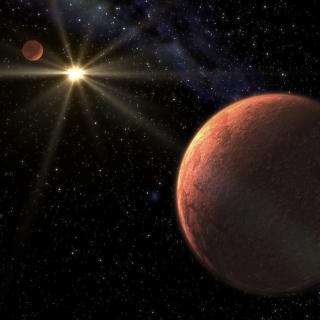
Context. Super-Earths and mini-Neptunes are missing from our Solar System, yet they appear to be the most abundant planetary types in our Galaxy. A detailed characterization of key planets within this population is important for understanding the formation mechanisms of rocky and gas giant planets and the diversity of planetary interior structures. Aims. In 2019, NASA's TESS satellite found a transiting planet candidate in a 17.6-day orbit around the star TOI-283. We started radial velocity (RV) follow-up observations with ESPRESSO to obtain a mass measurement. Mass and radius are measurements critical for planetary classification and internal composition modeling. Methods. We used ESPRESSO spectra to derive the stellar parameters of the planet candidate host star TOI-283. We then performed a joint analysis of the photometric and RV data of this star, using Gaussian processes to model the systematic noise present in both datasets. Results. We find that the host is a bright K-type star (d = 82.4 pc, Teff = 5213 ± 70 K, V = 10.4 mag) with a mass and radius of M⋆ = 0.80 ± 0.01 M⊙ and R⋆ = 0.85 ± 0.03 R⊙. The planet has an orbital period of P = 17.617 days, a size of Rp = 2.34 ± 0.09 R⊕, and a mass of Mp = 6.54 ± 2.04 M⊕. With an equilibrium temperature of ~600 K and a bulk density of ρp = 2.81 ± 0.93 g cm−3, this planet is positioned in the mass-radius diagram where planetary models predict H2O- and H/He-rich envelopes. The ESPRESSO RV data also reveal a long-term trend that is probably related to the star's activity cycle. Further RV observations are required to confirm whether this signal originates from stellar activity or another planetary body in the system.
Proyectos relacionados

Exoplanetas y Astrobiología
La búsqueda de vida en el Universo se ha visto impulsada por los recientes descubrimientos de planetas alrededor de otras estrellas (los llamados exoplanetas), convirtiéndose en uno de los campos más activos dentro de la Astrofísica moderna. En los últimos años los descubrimientos cada vez más numerosos de nuevos exoplanetas y los últimos avances
Enric
Pallé Bago
Estrellas de Baja Masa, Enanas Marrones y Planetas
Se investigan los procesos que conducen a la formación de estrellas de baja masa, enanas marrones y exoplanetas y caracterizar las propiedades físicas de estos astros en varias etapas evolutivas. Las estrellas de muy baja masa y las enanas marrones son probablemente los objetos más numerosos de nuestra Galaxia, pero no por ello están
Rafael
Rebolo López