
Small Bodies of the Solar System

    General
    Description

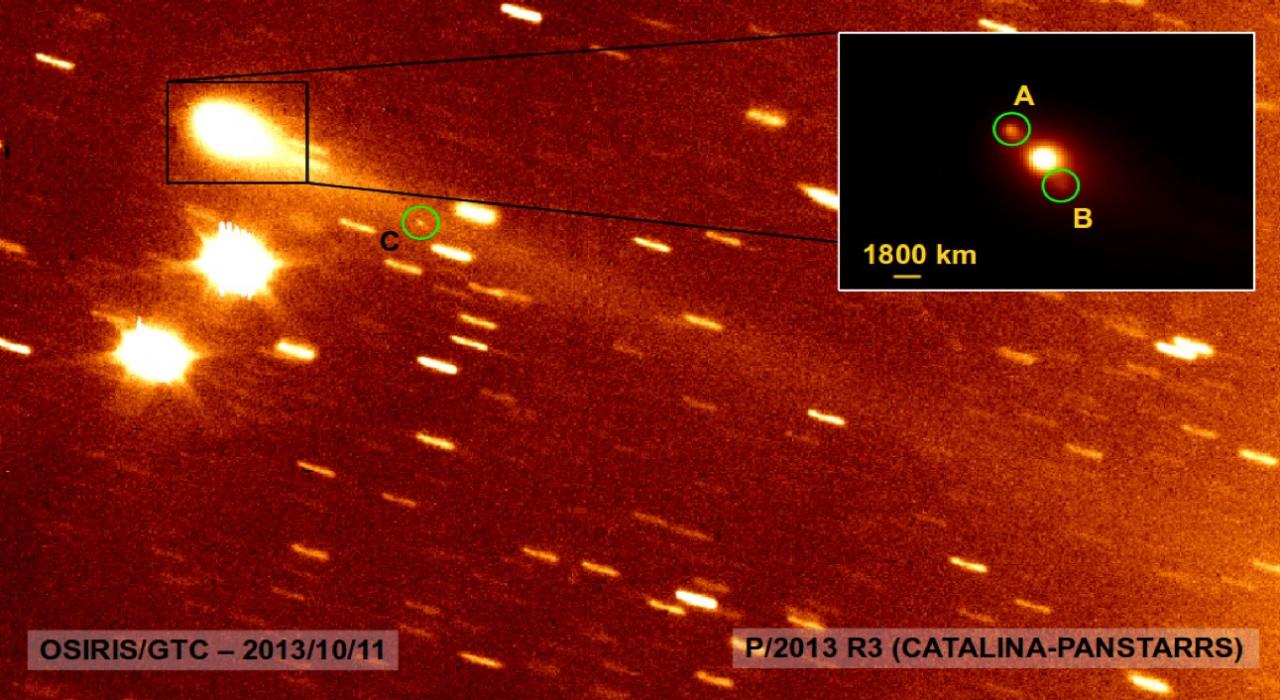
    This project studies the physical and compositional properties of the so-called minor bodies of the Solar System, that includes asteroids, icy objects, and comets. Of special interest are the trans-neptunian objects (TNOs), including those considered the most distant objects detected so far (Extreme-TNOs or ETNOs); the comets and the comet-asteroid transitional objects (Centaurs and main belt comets or MBCs); the primitive asteroids. The last two groups contain the most primordial and pristine material of the Solar System and so they provide the clues to understand the origin and the subsequent evolution of our system. Among asteroid population, the near-Earth asteroids or NEAs, as well as the potentially hazardous asteroids (PHAs) are of particular interest: due to their proximity to the Earth, they are the most accesible to spacecraft and so are ideal for in-situ or even sample-return space missions. In addition they are considered as future potential resources of materials (asteroid mining), and they are also impact hazards for the Earth. Regarding primitive asteroids, it is remarkable the spectroscopic survey (visible and near-infrared) led by the PI of this project (PRIMitive Asteroids Spectroscopic Survey - PRIMASS). This survey received financial support from NASA (17-PDART17_2-0097, PI: N. Pinilla-Alonso, 137.000€ - 2 years) in order to upload and archive at the Small Bodies Node of the NASA Planetary Data System the more than 800 spectra obtained.

    The compositional surface properties, as well as the physical and thermal properties of these objects are inferred through imaging, photometry, and spectroscopy in a wide range of wavelengths (from 0.35 up to 24 microns). Data are interpreted using scattering and thermo-physical models. This project works also in the study of the physical properties of the cometary nuclei, as well as properties of dust and coma in the tails of the MBCs and the mechanisms that generate them.

    This group maintains several international collaborations with other groups, and some of their members are also members of (1) the Science Team of the NASA OSIRIS-REx mission, in particular the Image Processing Working Group, were they work with the images obtained with the OCAMS suite of cameras; (2) the coordination of an international group to study NEAs (EURONEAR); (3) the central core of the proponents of ESA M5 missions CASTALIA, CASTAway, and Hera; (4) the Center for Lunar and Asteroid Surface Science - CLASS (NASA); (5) the Solar System group of the Euclid consortium; (6) the surveys J-PLUS and J-PASS for the exploitation of observations of Solar System objects; (7) the Solar System working group of Gaia and JWST.
    Principal investigator
    Project manager
    Collaborators
    Dr.
    Noemí Pinilla-Alonso
    Dr.
    Humberto Campins
    Dr.
    Fernando Moreno Danvila
    Dr.
    Y. Fernández
    Dr.
    José Luis Ortiz
    Dr.
    R. Duffard
    Prof.
    R. Hil-Hutton

    Related publications

    Pre-perihelion detection of a wobbling high-latitude jet in the interstellar comet 3I/ATLAS 2025A&A...705L...3S
    Pan-STARRS Follow-up of the Gravitational-wave Event S250818k and the Light Curve of SN2025ulz 2025ApJ...995L..27G
    Accurate geometric albedo, shape, and size of Hi'iaka from a stellar occultation 2025NatCo..1610926F
    ATLAS Photometry of Interstellar Object 3I/ATLAS 2025ApJ...995L..15T
    HyperScout-H: The Hyperspectral Imager for the ESA Hera Mission 2025SSRv..221..112P
    Compositional characterisation of asteroid (84) Klio with JWST 2025A&A...703A.211L
    Nitrogen-bearing Species on Trans-Neptunian Objects Revealed by JWST/DiSCo-TNOs 2025ApJ...993..188C
    Error dependencies in the space-based CNEOS fireball database 2025A&A...701A.202P
    The Hera Space Mission in the Context of Small Near-Earth Asteroid Missions in the Past, Present and Future 2025SSRv..221...70M
    Assessing interstellar comet 3I/ATLAS with the 10.4 m Gran Telescopio Canarias and the Two-meter Twin Telescope 2025A&A...700L...9D
    JWST mid-infrared spectroscopy of centaurs and small trans-Neptunian objects: Linking the inner and outer Solar System 2025A&A...699A.167V
    Observation of Diffuse Galactic Light Near the Galactic Center with ONC-T on Board Hayabusa2 2025ApJ...988...12S
    Monitoring of asteroids in cometary orbits and activated asteroids through archival images and new observations 2025A&A...698A.117M
    Asteroid sizes determined with thermophysical model and stellar occultations 2025A&A...698A.298C
    Size and shape of the trans-Neptunian object (470316) 2007 OC10: Comparison with thermal data 2025A&A...697A.157G
    Near-infrared spectral variation in Ryugu particles and implication for rapid space weathering by solar UV radiation 2025NatSR..1514613F
    Few EURONEAR NEA mini-surveys observed with the INT, KASI and T80S telescopes during the ParaSOL synthetic tracking project 2025NewA..11902410V
    2020 BX<SUB>12</SUB>—The Last Binary Asteroid Discovered at Arecibo 2025PSJ.....6...91Z
    Shape and spin-state model of tumbling asteroid (319) Leona 2025A&A...696A..76D
    Water in Ryugu as a property of processes in its parent body 2025A&A...695A.168L
    Spectral Diversity of DiSCo's TNOs Revealed by JWST: Early Sculpting and Late Irradiation 2025ApJ...982L...8B
    Thermal evolution of trans-Neptunian objects through observations of Centaurs with JWST 2025NatAs...9..245L
    Widespread CO<SUB>2</SUB> and CO ices in the trans-Neptunian population revealed by JWST/DiSCo-TNOs 2025NatAs...9..252D
    A JWST/DiSCo-TNOs portrait of the primordial Solar System through its trans-Neptunian objects 2025NatAs...9..230P
    Irradiation origin and stability of CO on trans-Neptunian objects: Laboratory constraints and observational evidence from JWST/DiSCo-TNOs 2025A&A...694A.126H
    Ground-based Characterization of (98943) Torifune 2001 CC<SUB>21</SUB>, the Target of the Hayabusa2# Space Mission 2025PSJ.....6...42P
    Basaltic quasi-mini-moon: Characterizing 2024 PT<SUB>5</SUB> with the 10.4 m Gran Telescopio Canarias and the Two-meter Twin Telescope 2025A&A...694L...5D
    Near-ultraviolet absorption distribution of primitive asteroids from photometric surveys: II. Collisional families 2025A&A...693A.140T
    Physical properties of five near-Earth asteroids within the NEOROCKS project 2024MNRAS.535.3479M
    Unveiling the ice and gas nature of active centaur (2060) Chiron using the James Webb Space Telescope 2024A&A...692L..11P
    The physical properties of two potential targets for space missions: (155140) 2005 UD and (612267) 2001 SG286 2024MNRAS.535.3077G
    Physical properties of trans-Neptunian object (143707) 2003 UY<SUB>117</SUB> derived from stellar occultation and photometric observations 2024A&A...691A..31K
    Near-infrared Spectral Homogeneity of the Didymos System Before and After the DART Impact 2024PSJ.....5..225I
    Light-curve analysis and shape models of NEAs 7335, 7822, 154244, and 159402 2024MNRAS.533.4160R
    Comparison of optical spectra between asteroids Ryugu and Bennu: II. High-precision analysis for space weathering trends 2024Icar..42016204Y
    2023 DZ2 Planetary Defense Campaign 2024PSJ.....5..141R
    Comparison of optical spectra between asteroids Ryugu and Bennu: I. Cross calibration between Hayabusa2/ONC-T and OSIRIS-REx/MapCam 2024Icar..41716122Y
    Asteroid reflectance spectra from Gaia DR3: Near-UV in primitive asteroids 2024A&A...686A..76T
    Dynamics of 2023 FW<SUB>14</SUB>, the second L<SUB>4</SUB> Mars trojan, and a physical characterization using the 10.4 m Gran Telescopio Canarias 2024A&A...683L..14D
    Pre-perihelion monitoring of interstellar comet 2I/Borisov 2024MNRAS.529.3521P