
Bibcode
Cifuentes, C.; Caballero, J. A.; González-Payo, J.; Amado, P. J.; Béjar, V. J. S.; Burgasser, A. J.; Cortés-Contreras, M.; Lodieu, N.; Montes, D.; Quirrenbach, A.; Reiners, A.; Ribas, I.; Sanz-Forcada, J.; Seifert, W.; Zapatero Osorio, M. R.
Referencia bibliográfica
Astronomy and Astrophysics
Fecha de publicación:
1
2025
Revista
Número de citas
33
Número de citas referidas
28
Descripción
Context. Multiplicity studies greatly benefit from focusing on M dwarfs because they are often paired in a variety of configurations with both stellar and substellar objects, including exoplanets. Aims. We aim to address the observed multiplicity of M dwarfs by conducting a systematic analysis using the latest available astropho-tometric data. Methods. For every star in a sample of 2214 M dwarfs from the CARMENES catalogue, we investigated the existence of resolved and unresolved physical companions in the literature and in all-sky surveys, especially in Gaia DR3 data products. We covered a very wide range of separations, from known spectroscopic binaries in tight arrangements (~0.01 au) to remarkably separated ultra-wide pairs (~105 au). Results. We identified 835 M dwarfs in 720 multiple systems, predominantly binaries. Thus, we propose 327 new binary candidates based on Gaia data. If these candidates are finally confirmed, we expect the multiplicity fraction of M dwarfs to be 40.3‑2.0+2.1%. When only considering the systems already identified, the multiplicity fraction is reduced to 27.8‑1.8+1.9%. This result is in line with most of the values published in the literature. We also identified M-dwarf multiple systems with FGK, white dwarf, ultra-cool dwarf, and exoplanet companions, as well as those in young stellar kinematic groups. We studied their physical separations, orbital periods, binding energies, and mass ratios. Conclusions. We argue that based on reliable astrometric data and spectroscopic investigations from the literature (even when considering detection biases), the multiplicity fraction of M dwarfs could still be significantly underestimated. This calls for further high-resolution follow-up studies to validate these findings.
Proyectos relacionados
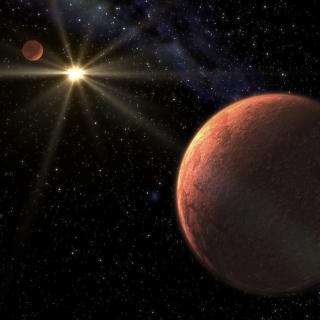
Estrellas de Baja Masa, Enanas Marrones y Planetas
Se investigan los procesos que conducen a la formación de estrellas de baja masa, enanas marrones y exoplanetas y caracterizar las propiedades físicas de estos astros en varias etapas evolutivas. Las estrellas de muy baja masa y las enanas marrones son probablemente los objetos más numerosos de nuestra Galaxia, pero no por ello están
Rafael
Rebolo López

Exoplanetas y Astrobiología
La búsqueda de vida en el Universo se ha visto impulsada por los recientes descubrimientos de planetas alrededor de otras estrellas (los llamados exoplanetas), convirtiéndose en uno de los campos más activos dentro de la Astrofísica moderna. En los últimos años los descubrimientos cada vez más numerosos de nuevos exoplanetas y los últimos avances
Enric
Pallé Bago