
Bibcode
Veenema, Oscar; Thatte, Niranjan; Rigopoulou, Dimitra; García-Bernete, Ismael; Alonso-Herrero, Almudena; Audibert, Anelise; Bellocchi, Enrica; Bunker, Andrew J.; Campbell, Steph; Combes, Francoise; Davies, Ric I.; Delaney, Daniel; Donnan, Fergus; Esposito, Federico; García-Burillo, Santiago; Gonzalez Martin, Omaira; Hermosa Muñoz, Laura; Hicks, Erin K. S.; Hoenig, Sebastian F.; Levenson, Nancy A.; Packham, Chris; Pereira-Santaella, Miguel; Ramos Almeida, Cristina; Ricci, Claudio; Riffel, Rogemar A.; Rosario, David; Zhang, Lulu
Referencia bibliográfica
Monthly Notices of the Royal Astronomical Society
Fecha de publicación:
12
2025
Número de citas
6
Número de citas referidas
4
Descripción
We present combined James Webb Space Telescope (JWST) NIRSpec and MIRI/MRS integral field spectroscopy data of the nuclear and circumnuclear regions of the highly dust obscured Seyfert 2 galaxy NGC 7582, which is part of the sample of active galactic nucleaus (AGN) in the Galaxy Activity, Torus and Outflow Survey (GATOS). Spatially resolved analysis of the pure rotational H$_2$ lines (S(1)─S(7)) reveals a characteristic power-law temperature distribution in different apertures, with the two prominent southern star-forming regions exhibiting unexpectedly high molecular gas temperatures, comparable to those in the AGN powered nuclear region. We investigate potential heating mechanisms including direct AGN photoionization, UV fluorescent excitation from young star clusters, and shock excitation. We find that shock heating gives the most plausible explanation, consistent with multiple near- and mid-IR tracers and diagnostics. Using photoionization models from the PhotoDissociation Region Toolbox, we quantify the ISM conditions in the different regions, determining that the southern star-forming regions have a high density ($n_\mathrm{ H} \sim 10^{5}$ cm$^{-3}$) and are irradiated by a moderate UV radiation field ($G_0 \sim 10^{3}$ Habing). Fitting a suite of Paris-Durham shock models to the rotational H$_2$ lines, as well as rovibrational 1-0 S(1), 1-0 S(2), and 2-1 S(1) H$_2$ emission lines, we find that a slow ($v_s \sim 10$ km s−1) C-type shock is likely responsible for the elevated temperatures. Our analysis loosely favours local starburst activity as the driver of the shocks and circumnuclear gas dynamics in NGC 7582, though the possibility of an AGN jet contribution cannot be excluded.
Proyectos relacionados
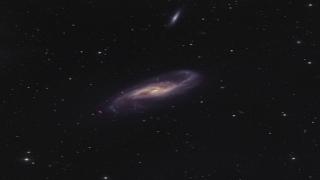
Las Galaxias Espirales: Evolución y Consecuencias
Nuestro grupo pequeño esta bien conocido y respetado internacionalmente por nuestro trabajo inovativo e importante en varios aspectos de la estructura y la evolución de las galaxias espirales cercanas. Usamos principalmente observaciones en varias longitudes de onda, explotando las sinergías que nos permiten responder a las cuestiones más
Johan Hendrik
Knapen Koelstra
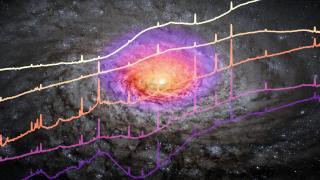
Actividad Nuclear en Galaxias: una Perspectiva 3D del Núcleo y su Entorno
Nuestro grupo se divide en dos líneas principales de investigación. En primer lugar, el estudio de los vientos producidos por cuásares luminosos oscurecidos y del impacto que estos tienen en sus galaxias anfitrionas (retroalimentación del AGN). Como parte de este proyecto, denominado QSOFEED (Quasar Feedback) hemos obtenido observaciones
Cristina
Ramos Almeida