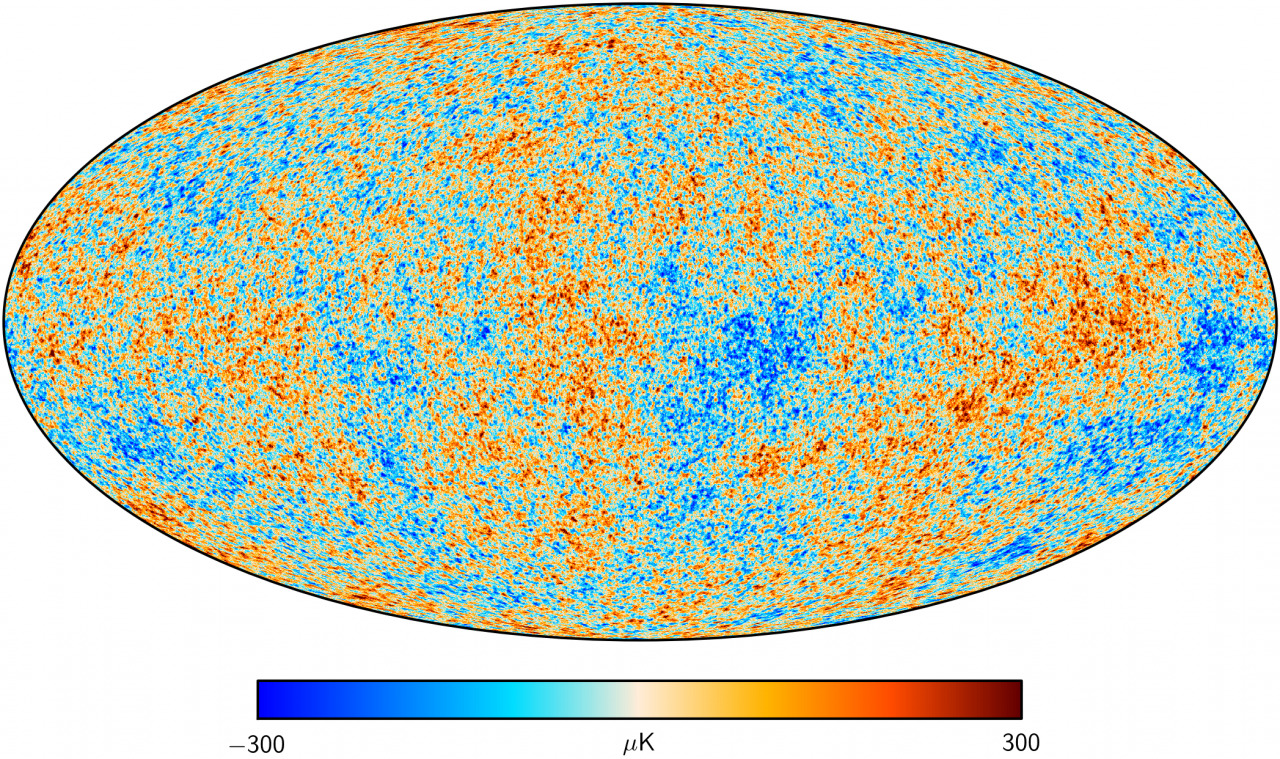
Anisotropy of the Cosmic Microwave Background

    General
    Description

    The general goal of this project is to determine and characterize the spatial and spectral variations in the temperature and polarisation of the Cosmic Microwave Background in angular scales from several arcminutes to several degrees. The primordial matter density fluctuations which originated the structure in the matter distribution of the present Universe, left imprinted inhomogeneities in the CMB temperature distribution, that are mathematically encoded in the so-called angular power spectrum. Initially, pioneering experiments like the COBE satellite (whose results deserved the Nobel Prize on Physics 2006) or the Tenerife CMB experiment demonstrated in the 90s that the level of anisotropy was about one part in a hundred thousands at angular scales of several degrees. Obtaining CMB maps at various frequencies with sufficient sensitivity to detect structures at this level is of fundamental importance to extract information on the power spectrum of primordial density fluctuations, to prove the existence of an inflationary period in the Early Universe and to establish the ultimate nature of the dark matter and dark energy. Recently, the WMAP satellite obtained CMB maps with unprecedented sensitivity that allowed to set restrictions on a large number of cosmological parameters.

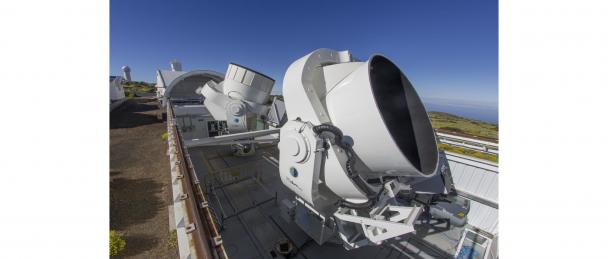
    The focus of this project is to undertake measurements at gradually higher angular resolutions and sensitivities, by using different experiments that have been operative from the Teide Observatory, like the Tenerife experiment, the IAC-Bartol experiment or the JBO-IAC interferometer. More recently, the Very Small Array interferometer performed observations between 1999 and 2008. At that time the COSMOSOMAS experiment was also operative, its goal having been not only the characterization of the primary CMB anisotropies but also the study and characterization of the Galactic foreground contamination. In more recent years the activity in this project has focused in the scientific exploitation of data from the Planck satellite, and in the development, operation and exploitation of the QUIJOTE experiment. Now that the Planck mission has been completed and finished, the activity is focused in the scientific exploitation of QUIJOTE, in the development of new instrumentation for QUIJOTE, and in in the development of new experiments that are being deployed or that will be deployed at the Teide Observatory: GroundBRID, STRIP, KISS and TMS.

    Principal investigator
    Project staff
    Collaborators
    Dr.
    Fernando Atrio Barandela
    Dr.
    Enrique Martínez González
    Dr.
    Carlos Hernández Monteagudo
    1. 6-7 june: XV QUIJOTE Scientific Meeting (IFCA, Santander)
    2. July: publication of the final results (12 articles) and data from the Planck satellite.
    3. 15-19 october: "CMB foregrounds for B-mode studies" conference, organised within the Radioforegrounds proyect, IV AME workshop, and XVI QUIJOTE Scientific Meeting (all these eventes were celebrated at the IAC)
    4. October: installation of the dome of the GroundBIRD experiment, at the Teide Observatory.
    5. December: aceptation of the third QUIJOTE scientific article (Poidevin et al. 2019)

    Related publications

    LiteBIRD science goals and forecasts: improved full-sky reconstruction of the gravitational lensing potential through the combination of Planck and LiteBIRD data 2025JCAP...11..073R
    First release of LiteBIRD simulations from an end-to-end pipeline 2025JCAP...11..042B
    On the computational feasibility of Bayesian end-to-end analysis of LiteBIRD simulations within Cosmoglobe 2025JCAP...11..041A
    A simulation framework for the LiteBIRD instruments 2025JCAP...11..040T
    Requirements on bandpass resolution and measurement precision for LiteBIRD 2025JCAP...10..038G
    Continuum, CO, and water vapour maps of the Orion Nebula: First millimetre spectral imaging with CONCERTO 2025A&A...701A.210D
    Deep Needlet: a CNN based full sky component separation method in Needlet space 2025JCAP...08..058A
    LiteBIRD science goals and forecasts: constraining isotropic cosmic birefringence 2025JCAP...07..083D
    On beam characterization of ground-based CMB radio telescopes using UAV-mounted sources: application to the QUIJOTE TFGI and plans for LSPE-Strip 2025JInst..20P6057P
    QUIJOTE scientific results: XVIII. New constraints on the polarisation of the anomalous microwave emission in bright Galactic regions: ρ Ophiuchi, Perseus, and W43 2025A&A...695A.245G
    The LSPE-Strip pointing reconstruction and Star Tracker 2025JInst..20P3029M
    Requirements on the gain calibration for LiteBIRD polarisation data with blind component separation 2025JCAP...01..019C
    LiteBIRD science goals and forecasts. Mapping the hot gas in the Universe 2024JCAP...12..026R
    Model-independent reconstruction of UV luminosity function and reionization epoch 2024JCAP...12..010A
    KISS: Instrument Description and Performance 2024PASP..136k4505M
    CONCERTO at APEX On-sky performance in continuum 2024A&A...689A..20H
    LiteBIRD science goals and forecasts: primordial magnetic fields 2024JCAP...07..086P
    Bayesian inference methodology to characterize the dust emissivity at far-infrared and submillimeter frequencies 2024MNRAS.531.4876A
    LSPE-Strip on-sky calibration strategy using bright celestial sources 2024JInst..19P6016G
    LiteBIRD science goals and forecasts: improving sensitivity to inflationary gravitational waves with multitracer delensing 2024JCAP...06..010N
    Impact of beam far side-lobe knowledge in the presence of foregrounds for LiteBIRD 2024JCAP...06..011L
    LiteBIRD science goals and forecasts: a full-sky measurement of gravitational lensing of the CMB 2024JCAP...06..009L
    Star-formation activity of low-mass galaxies at the peak epoch of galaxy formation probed by deep narrow-band imaging 2024MNRAS.531.2335D
    Fundamental physics with ESPRESSO: a new determination of the D/H ratio towards PKS1937-101 2024MNRAS.529..839G
    QUIJOTE Scientific Results - XVII. Studying the anomalous microwave emission in the Andromeda Galaxy with QUIJOTE-MFI 2024MNRAS.52711945F
    Pointing Calibration of GroundBIRD Telescope Using Moon Observation Data 2024PTEP.2024b3F01S
    A microwave blackbody target for cosmic microwave background spectral measurements in the 10–20 GHz range 2024JInst..19P2040A
    QUIJOTE scientific results - XIII. Intensity and polarization study of the microwave spectra of supernova remnants in the QUIJOTE-MFI wide survey: CTB 80, Cygnus Loop, HB 21, CTA 1, Tycho, and HB 9 2024MNRAS.527..171L
    A magnified compact galaxy at redshift 9.51 with strong nebular emission lines 2023Sci...380..416W
    Probing cosmic inflation with the LiteBIRD cosmic microwave background polarization survey 2023PTEP.2023d2F01A
    J-PLUS: Photometric Recalibration with the Stellar Color Regression Method and an Improved Gaia XP Synthetic Photometry Method 2023ApJS..269...58X
    The high optical brightness of the BlueWalker 3 satellite 2023Natur.623..938N
    Evolution of the Mass-Metallicity Relation from Redshift z ≈ 8 to the Local Universe 2023ApJ...957...39L
    DES Y3 cosmic shear down to small scales: Constraints on cosmology and baryons 2023A&A...678A.109A
    QUIJOTE scientific results - X. Spatial variations of Anomalous Microwave Emission along the Galactic plane 2023MNRAS.526.1343F
    Tensor-to-scalar ratio forecasts for extended LiteBIRD frequency configurations 2023A&A...676A..42F
    The JCMT BISTRO Survey: Studying the Complex Magnetic Field of L43 2023ApJ...952...29K
    Sensitivity Modeling for LiteBIRD 2023JLTP..211..384H
    The C-Band All-Sky Survey (C-BASS): new constraints on the integrated radio spectrum of M 31 2023MNRAS.523.3471H
    ALMA High-Level Data Products: submillimetre counterparts of SDSS quasars in the ALMA footprint 2023MNRAS.523...23W

    Related conferences

    • XIX Canary Islands Winter School of Astrophysics "The Cosmic Microwave | Background: from quantum fluctuations to the present Universe"
      Tenerife, Canary Islands
      Spain
      Date
      -
      Past
    Related projects
    Parte del equipo del IAC con el sistema de desarrollo del software de vuelo
    Herschel y Planck
    IAC participation in the HERSCHEL AND PLANCK SURVEYOR space missions. Since 1996 the Instituto de Astrofísica de Canarias has been a contributor to the concept and development processes for the scientific payload of the European Space Agency's (ESA) Herschel Space Observatory and Planck Surveyor missions.
    Jorge
    Casares Velázquez
    Ismael
    Pérez Fournon
    Rafael
    Rebolo López
    COSMOSOMAS
    COSMOSOMAS
    The COSMOSOMAS experiment was running for several years at the Observatorio del Teide, measuring fossil radiation of the universe arriving to the Earth in the form of microwaves.
    Rafael
    Rebolo López
    Polarímetro CMB instalado en Izaña
    Polarímetro CMB
    A Cosmic Microwave Background Polarimeter
    Rafael
    Rebolo López