Helio and Astero-Seismology and Exoplanets Search

    General
    Description

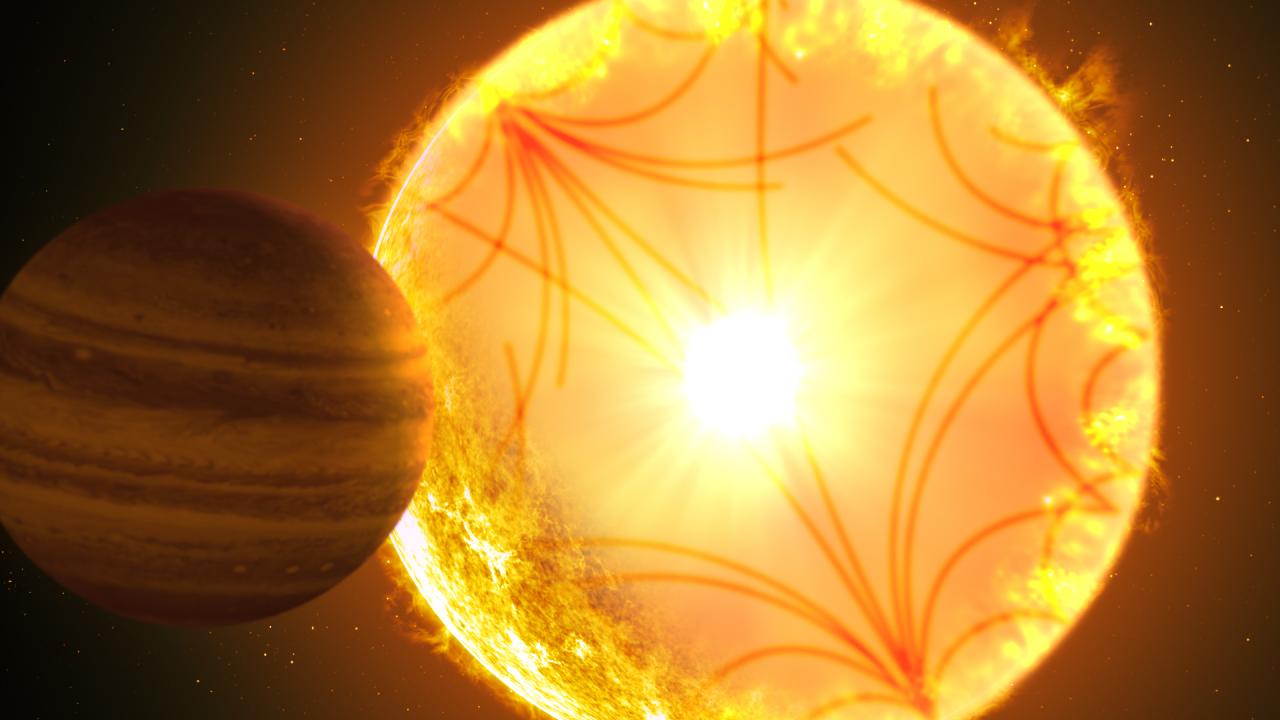
    The principal objectives of this project are: 1) to study the structure and dynamics of the solar interior, 2) to extend this study to other stars, 3) to search for extrasolar planets using photometric methods (primarily by transits of their host stars) and their characterization (using radial velocity information) and 4) the study of the planetary atmospheres.

    To reach our first objective, we use Global Helioseismology (analysis of the solar oscillation eigenmodes) and Local Helioseismology (that uses travel waves). Solar seismology allows to accurately infer information about the internal structure and dynamics of the Sun,. This project covers the various necessary aspects to attain the aforementioned objectives: instrumental, observational, reduction, analysis and interpretation of data and, finally, theoretical developments of inversion techniques and development of structure and evolution models.

    On the other hand, the Astroseismology aims to obtain a similar knowledge of other stars. Thanks to the huge number of stars observed by CoRoT, Kepler and TESS space missions it is possible to extract seismic global parameters of hundreds of stars; both solar type and red giants. Furthermore, the recent deployment and beginning of observations with the high precision spectrographs of the SONG (Stellar Observations Network Group) ground-based telescopes will substantially improve the characterization of the eigenmodes spectrum in bright stars.

    The strategy of using planetary transits to discover new planets around other stars consists of the photometric detection of the dimming of the light of the star when one of its planets passes, or ‘transits’ in front of it. Currently this method is the preferred one for the study of small planets, not only due to its sensitivity, but also because this method allows a more detailed investigation of the planets found (e.g. Planetary atmospheres). This technique is similar to the one that is used for helio- and asteroseismology and so some of its methods are a logical extension from that. However, it is also important to develop new algorithms and observing methods for the unequivocal detection and analysis of planets and to be able to distinguish them from false alarms.

    The current horizon for studies of exoplanets with space missions involves new missions, beginning with the launch of CHEOPS, followed by TESS, JWST and in 2026, PLATO. Thus, there is presently a window of opportunity for ground-based facilities, and we are pursuing observations using mainly TNG, NOT y GTC.

    Principal investigator

    Milestones

    1. Beck et al. (2024, A&A, 682, A7) increased the number of known solar-like oscillators in binary systems by about an order of magnitude. Such large sample allowed us to study the effects co-evolution of stellar evolution on the evolution of the binary orbits. Featured as "ESA Gaia image of the Week".
    2. Following the participation to the roadmaps in astrophysics for the ESA’s Human and Robotic Exploration Directorate in 2021, a paper in npj Microgravity was published where the key quetions in stellar physics were exposed along with proposed experiments for the future as part of that program (Mathur & Santos 2024).
    3. Merc et al. (2024, A&A, 683, A84) presented the first analysis of accretion-induced flickering variability in symbiotic binary stars from TESS lightcurves. This study significantly enlarged the known sample with such variability. This suggests that accretion disks are common in symbiotic stars.
    4. Solar magnetic activity in cycles 23&24 were analyzed by tracking GOLF low-degree p-mode frequency shifts across 3 bands, probing depths of 74–1575 km. Results suggest magnetic variations mainly occur near the surface. In cycle 24, shifts appeared earlier at high latitudes and coincided with surface activity near the equator, with stronger shifts at shallower depths.

    Related publications

    Beyond the Nyquist frequency: Asteroseismic catalog of undersampled Kepler late subgiants and early red giants 2025A&A...702A.144L
    TOI-1438: A rare system with two short-period sub-Neptunes and a tentative long-period Jupiter-like planet orbiting a K0V star 2025A&A...702A..69P
    Luminaries in the sky: The TESS legacy sample of bright stars: I. Asteroseismic detections in naked-eye main-sequence and subgiant solar-like oscillators 2025A&A...701A.285L
    The impact of rotation on the stochastic excitation of stellar acoustic modes in solar-like pulsators 2025A&A...700A..25B
    Non-transiting exoplanets as a means of understanding star–planet interactions in close-in systems 2025A&A...699A.226G
    The TOI-2427 system: Two close-in planets orbiting a late K-dwarf star 2025A&A...699A.185S
    Structure and Dynamics of the Sun's Interior Revealed by the Helioseismic and Magnetic Imager 2025SoPh..300...70K
    Red giant evolutionary status determination: The complete Kepler catalog 2025A&A...697A.165V
    Signature of spin-down stalling in stellar magnetic activity: The case of the open cluster NGC 6811 2025A&A...697A.177S
    Kepler meets Gaia DR3: Homogeneous extinction-corrected color-magnitude diagram and binary classification 2025A&A...696A.243G
    The PLATO mission 2025ExA....59...26R
    Improving the stellar age determination through joint modeling of binarity and asteroseismology: Grid modeling of the seismic red giant binary KIC 9163796 2025A&A...696A..42G
    Magnetic Activity Evolution of Solar-like Stars. II. S<SUB>ph</SUB>–Ro Evolution of Kepler Main-sequence Targets 2025ApJ...982..114M
    APOKASC-3: The Third Joint Spectroscopic and Asteroseismic Catalog for Evolved Stars in the Kepler Fields 2025ApJS..276...69P
    TOI-2458 b: A mini-Neptune consistent with in situ hot Jupiter formation 2025A&A...693A.235S
    Symbiotic stars, weird novae, and related embarrassing binaries 2024NatAs...8.1504M
    Unequivocal detection of the tidal deformation of a red giant in a binary system via interferometry 2024A&A...692A.218M
    Hints of a close outer companion to the ultra-hot Jupiter TOI-2109 b 2024A&A...692A.254H
    The CHEOPS view of the climate of WASP-3 b 2024A&A...692A.129S
    Seismic differences between solar magnetic cycles 23 and 24 for low-degree modes 2024A&A...691L..20G
    Architecture of TOI-561 planetary system 2024MNRAS.535.2763P
    An ultra-short-period super-Earth with an extremely high density and an outer companion 2024NatSR..1427219L
    The curious case of 2MASS J15594729+4403595, an ultra-fast M2 dwarf with possible Rieger cycles 2024A&A...691A.117M
    The K2-24 planetary system revisited by CHEOPS 2024A&A...690A.349N
    Perspectives on the physics of late-type stars from beyond low earth orbit, the moon and mars 2024npjMG..10...96M
    Five new eclipsing binaries with low-mass companions 2024A&A...690A.168L
    HR 10 as seen by CHEOPS and TESS: Revealing δ Scuti pulsations, granulation-like signal and hint for transients 2024A&A...690A..73S
    Measuring stellar surface rotation and activity with the PLATO mission: I. Strategy and application to simulated light curves 2024A&A...689A.229B
    Photo-dynamical characterisation of the TOI-178 resonant chain. Exploring the robustness of transit-timing variations and radial velocity mass characterisations 2024A&A...688A.211L
    Characterisation of the warm-Jupiter TOI-1130 system with CHEOPS and a photo-dynamical approach 2024A&A...689A..52B
    Unveiling the internal structure and formation history of the three planets transiting HIP 29442 (TOI-469) with CHEOPS 2024A&A...688A.223E
    TOI-1408: Discovery and Photodynamical Modeling of a Small Inner Companion to a Hot Jupiter Revealed by Transit Timing Variations 2024ApJ...971L..28K
    A low-mass sub-Neptune planet transiting the bright active star HD 73344 2024A&A...688A..14S
    TOI-757 b: an eccentric transiting mini-Neptune on a 17.5-d orbit 2024MNRAS.533....1A
    CHEOPS in-flight performance. A comprehensive look at the first 3.5 yr of operations 2024A&A...687A.302F
    Detection of an Earth-sized exoplanet orbiting the nearby ultracool dwarf star SPECULOOS-3 2024NatAs...8..865G
    Gaia22dkvLb: A Microlensing Planet Potentially Accessible to Radial-velocity Characterization 2024AJ....168...62W
    Precise characterisation of HD 15337 with CHEOPS: A laboratory for planet formation and evolution 2024A&A...686A.282R
    HIP 41378 observed by CHEOPS: Where is planet d? 2024A&A...686L..18S
    Characterisation of the TOI-421 planetary system using CHEOPS, TESS, and archival radial velocity data 2024A&A...686A.301K