Helio and Astero-Seismology and Exoplanets Search

    General
    Description

    The principal objectives of this project are: 1) to study the structure and dynamics of the solar interior, 2) to extend this study to other stars, 3) to search for extrasolar planets using photometric methods (primarily by transits of their host stars) and their characterization (using radial velocity information) and 4) the study of the planetary atmospheres.

    To reach our first objective, we use Global Helioseismology (analysis of the solar oscillation eigenmodes) and Local Helioseismology (that uses travel waves). Solar seismology allows to accurately infer information about the internal structure and dynamics of the Sun,. This project covers the various necessary aspects to attain the aforementioned objectives: instrumental, observational, reduction, analysis and interpretation of data and, finally, theoretical developments of inversion techniques and development of structure and evolution models.

    On the other hand, the Astroseismology aims to obtain a similar knowledge of other stars. Thanks to the huge number of stars observed by CoRoT, Kepler and TESS space missions it is possible to extract seismic global parameters of hundreds of stars; both solar type and red giants. Furthermore, the recent deployment and beginning of observations with the high precision spectrographs of the SONG (Stellar Observations Network Group) ground-based telescopes will substantially improve the characterization of the eigenmodes spectrum in bright stars.

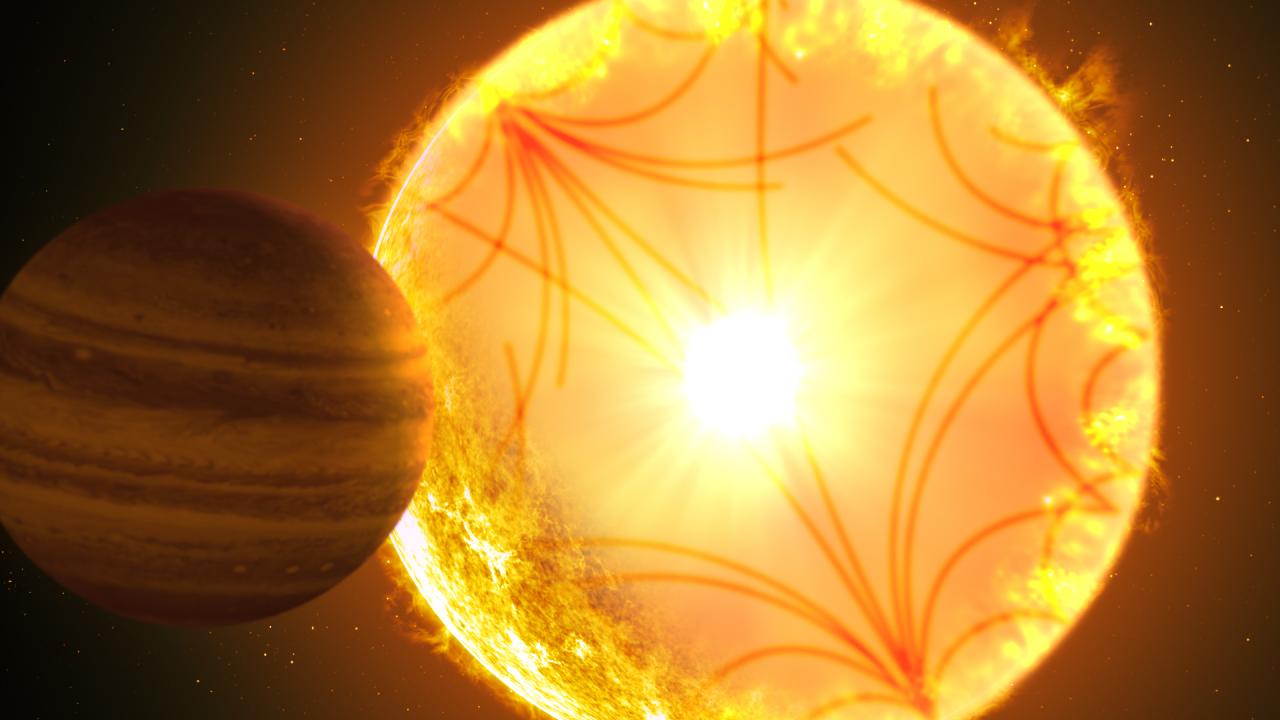
    The strategy of using planetary transits to discover new planets around other stars consists of the photometric detection of the dimming of the light of the star when one of its planets passes, or ‘transits’ in front of it. Currently this method is the preferred one for the study of small planets, not only due to its sensitivity, but also because this method allows a more detailed investigation of the planets found (e.g. Planetary atmospheres). This technique is similar to the one that is used for helio- and asteroseismology and so some of its methods are a logical extension from that. However, it is also important to develop new algorithms and observing methods for the unequivocal detection and analysis of planets and to be able to distinguish them from false alarms.

    The current horizon for studies of exoplanets with space missions involves new missions, beginning with the launch of CHEOPS, followed by TESS, JWST and in 2026, PLATO. Thus, there is presently a window of opportunity for ground-based facilities, and we are pursuing observations using mainly TNG, NOT y GTC.

    Principal investigator

    Milestones

    1. Beck et al. (2024, A&A, 682, A7) increased the number of known solar-like oscillators in binary systems by about an order of magnitude. Such large sample allowed us to study the effects co-evolution of stellar evolution on the evolution of the binary orbits. Featured as "ESA Gaia image of the Week".
    2. Following the participation to the roadmaps in astrophysics for the ESA’s Human and Robotic Exploration Directorate in 2021, a paper in npj Microgravity was published where the key quetions in stellar physics were exposed along with proposed experiments for the future as part of that program (Mathur & Santos 2024).
    3. Merc et al. (2024, A&A, 683, A84) presented the first analysis of accretion-induced flickering variability in symbiotic binary stars from TESS lightcurves. This study significantly enlarged the known sample with such variability. This suggests that accretion disks are common in symbiotic stars.
    4. Solar magnetic activity in cycles 23&24 were analyzed by tracking GOLF low-degree p-mode frequency shifts across 3 bands, probing depths of 74–1575 km. Results suggest magnetic variations mainly occur near the surface. In cycle 24, shifts appeared earlier at high latitudes and coincided with surface activity near the equator, with stronger shifts at shallower depths.

    Related publications

    The Mark-I helioseismic experiment - I. Measurements of the solar gravitational redshift (1976-2013) 2014MNRAS.443.1837R
    Confirmation of an exoplanet using the transit color signature: Kepler-418b, a blended giant planet in a multiplanet system 2014A&A...567A..14T
    Oscillation mode linewidths and heights of 23 main-sequence stars observed by Kepler 2014A&A...566A..20A
    Recovering Long-term Aerosol Optical Depth Series (1976-2012) from an Astronomical Potassium-based Resonance Scattering Spectrometer 2014AMTD....7.4093B
    Re-construction of global solar radiation time series from 1933 to 2013 at the Izaña Atmospheric Observatory 2014AMTD....7.4191G
    Seismic analysis of HD 43587Aa, a solar-like oscillator in a multiple system 2014A&A...564A..34B
    Seismic constraints on the radial dependence of the internal rotation profiles of six Kepler subgiants and young red giants 2014A&A...564A..27D
    Study of KIC 8561221 observed by Kepler: an early red giant showing depressed dipolar modes 2014A&A...563A..84G
    Stellar Observations Network Group: The prototype is nearly ready 2014IAUS..301...69G
    Magnetic activity of F stars observed by Kepler 2014A&A...562A.124M
    Transiting exoplanets from the CoRoT space mission. XXV. CoRoT-27b: a massive and dense planet on a short-period orbit 2014A&A...562A.140P
    Kepler-91b: a planet at the end of its life. Planet and giant host star properties via light-curve variations 2014A&A...562A.109L
    Asteroseismic Fundamental Properties of Solar-type Stars Observed by the NASA Kepler Mission 2014ApJS..210....1C
    A Full-Sun Magnetic Index from Helioseismology Inferences 2014SoPh..289..503G
    An in-depth study of HD 174966 with CoRoT photometry and HARPS spectroscopy. Large separation as a new observable for δ Scuti stars 2013A&A...559A..63G
    CoRoT: Harvest of the exoplanet program 2013Icar..226.1625M
    Differential asteroseismic study of seismic twins observed by CoRoT. Comparison of HD 175272 with HD 181420 2013A&A...558A..79O
    The Dynamics of the Solar Radiative Zone 2013SoPh..287...43E
    Kepler-77b: a very low albedo, Saturn-mass transiting planet around a metal-rich solar-like star⋆⋆⋆⋆⋆⋆ 2013A&A...557A..74G
    High angular resolution imaging and infrared spectroscopy of CoRoT candidates 2013A&A...556A..75G
    Atmospheric parameters of 169 F-, G-, K- and M-type stars in the Kepler field 2013MNRAS.434.1422M
    Transiting exoplanets from the CoRoT space mission. XXIV. CoRoT-25b and CoRoT-26b: two low-density giant planets 2013A&A...555A.118A
    The unusual roAp star KIC 8677585 2013MNRAS.432.2808B
    Asteroseismology of KIC 11754974: a high-amplitude SX Phe pulsator in a 343-d binary system 2013MNRAS.432.2284M
    Two new SB2 binaries with main sequence B-type pulsators in the Kepler field 2013A&A...553A.127P
    Spectrum analysis of bright Kepler late B- to early F-stars 2013MNRAS.431.3685T
    CoRoT 101186644: A transiting low-mass dense M-dwarf on an eccentric 20.7-day period orbit around a late F-star. Discovered in the CoRoT lightcurves 2013A&A...553A..30T
    Mode Parameters of δ Scuti Stars V830 Her and HD 163032 with Four-Year Data from the Taiwan Automated Telescope Network 2013PASP..125...31F
    Constraining magnetic-activity modulations in three solar-like stars observed by CoRoT and NARVAL 2013A&A...550A..32M
    Secondary eclipses in the CoRoT light curves. A homogeneous search based on Bayesian model selection 2013A&A...550A..67P
    Using a Mesoscale Meteorological Model to Reduce the Effect of Tropospheric Water Vapour from DInSAR Data: A Case Study for the Island of Tenerife, Canary Islands 2012PApGe.169.1425E
    Ground-based multi-color photometry of the γ Doradus-δ Scuti hybrid star KIC 6761539 2012AN....333.1077H
    SONG-OT: The prototype SONG node at Tenerife 2012AN....333.1103U
    Presentation of the reduction pipeline of the SONG échelle spectrograph 2012AN....333.1107T
    Study of HD 169392A observed by CoRoT and HARPS 2013A&A...549A..12M
    Characterizing Two Solar-type Kepler Subgiants with Asteroseismology: KIC 10920273 and KIC 11395018 2013ApJ...763...49D
    From CoRoT 102899501 to the Sun. A time evolution model of chromospheric activity on the main sequence 2012A&A...548A..15G
    Pulsational amplitude growth of the star KIC 3429637 (HD 178875) in the context of Am and ρ Pup stars 2012MNRAS.427.1418M
    Misleading variations in estimated rotational frequency splittings of solar p modes: consequences for helioseismology and asteroseismology 2012MNRAS.422.3564B
    Intermediate Resolution Near-infrared Spectroscopy of 36 Late M Dwarfs 2012AJ....144...99D