Helio and Astero-Seismology and Exoplanets Search

    General
    Description

    The principal objectives of this project are: 1) to study the structure and dynamics of the solar interior, 2) to extend this study to other stars, 3) to search for extrasolar planets using photometric methods (primarily by transits of their host stars) and their characterization (using radial velocity information) and 4) the study of the planetary atmospheres.

    To reach our first objective, we use Global Helioseismology (analysis of the solar oscillation eigenmodes) and Local Helioseismology (that uses travel waves). Solar seismology allows to accurately infer information about the internal structure and dynamics of the Sun,. This project covers the various necessary aspects to attain the aforementioned objectives: instrumental, observational, reduction, analysis and interpretation of data and, finally, theoretical developments of inversion techniques and development of structure and evolution models.

    On the other hand, the Astroseismology aims to obtain a similar knowledge of other stars. Thanks to the huge number of stars observed by CoRoT, Kepler and TESS space missions it is possible to extract seismic global parameters of hundreds of stars; both solar type and red giants. Furthermore, the recent deployment and beginning of observations with the high precision spectrographs of the SONG (Stellar Observations Network Group) ground-based telescopes will substantially improve the characterization of the eigenmodes spectrum in bright stars.

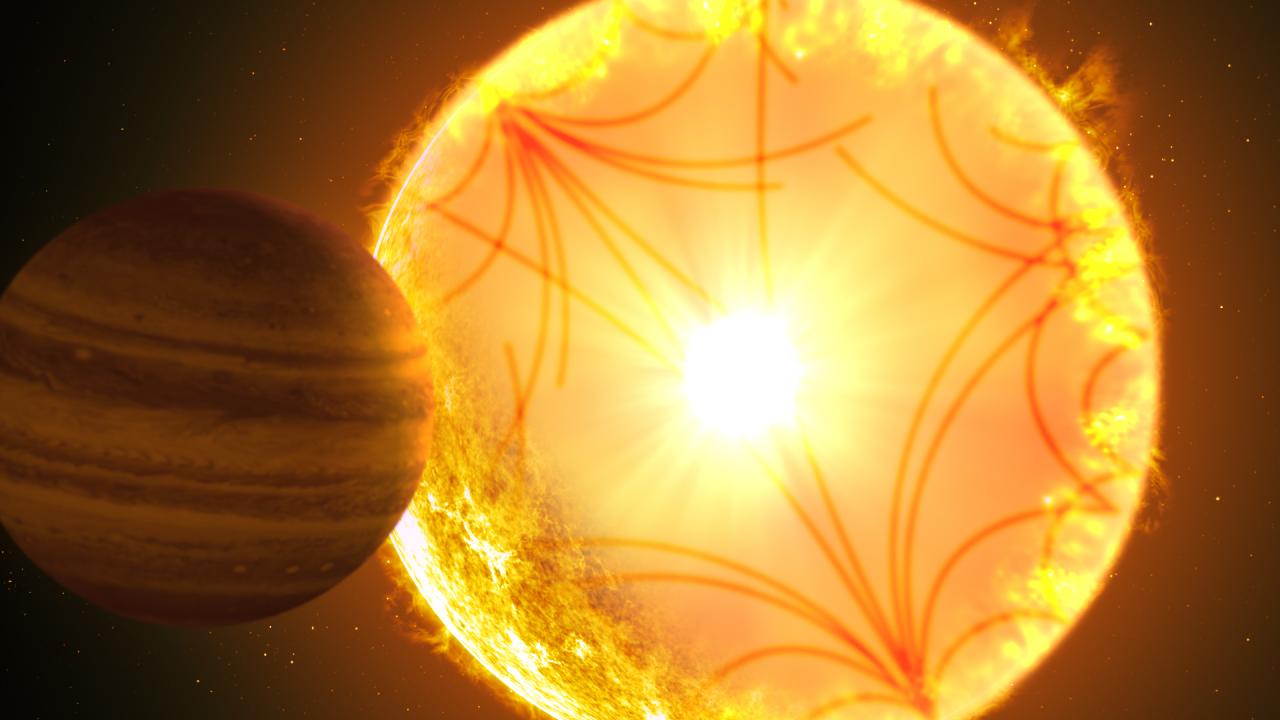
    The strategy of using planetary transits to discover new planets around other stars consists of the photometric detection of the dimming of the light of the star when one of its planets passes, or ‘transits’ in front of it. Currently this method is the preferred one for the study of small planets, not only due to its sensitivity, but also because this method allows a more detailed investigation of the planets found (e.g. Planetary atmospheres). This technique is similar to the one that is used for helio- and asteroseismology and so some of its methods are a logical extension from that. However, it is also important to develop new algorithms and observing methods for the unequivocal detection and analysis of planets and to be able to distinguish them from false alarms.

    The current horizon for studies of exoplanets with space missions involves new missions, beginning with the launch of CHEOPS, followed by TESS, JWST and in 2026, PLATO. Thus, there is presently a window of opportunity for ground-based facilities, and we are pursuing observations using mainly TNG, NOT y GTC.

    Principal investigator

    Milestones

    1. Beck et al. (2024, A&A, 682, A7) increased the number of known solar-like oscillators in binary systems by about an order of magnitude. Such large sample allowed us to study the effects co-evolution of stellar evolution on the evolution of the binary orbits. Featured as "ESA Gaia image of the Week".
    2. Following the participation to the roadmaps in astrophysics for the ESA’s Human and Robotic Exploration Directorate in 2021, a paper in npj Microgravity was published where the key quetions in stellar physics were exposed along with proposed experiments for the future as part of that program (Mathur & Santos 2024).
    3. Merc et al. (2024, A&A, 683, A84) presented the first analysis of accretion-induced flickering variability in symbiotic binary stars from TESS lightcurves. This study significantly enlarged the known sample with such variability. This suggests that accretion disks are common in symbiotic stars.
    4. Solar magnetic activity in cycles 23&24 were analyzed by tracking GOLF low-degree p-mode frequency shifts across 3 bands, probing depths of 74–1575 km. Results suggest magnetic variations mainly occur near the surface. In cycle 24, shifts appeared earlier at high latitudes and coincided with surface activity near the equator, with stronger shifts at shallower depths.

    Related publications

    The GOLF-NG prototype and the solar European perspective for cosmic vision 2015-2025 2008JPhCS.118a2044T
    The Asteroseismic Potential of Kepler: First Results for Solar-Type Stars 2010ApJ...713L.169C
    The Acoustic Cutoff Frequency of the Sun and the Solar Magnetic Activity Cycle 2011ApJ...743...99J
    p-mode power variation with solar atmosphere as observed in the Na D1 and K spectral lines 2008AN....329..494S
    HELAS IT-platform: A new tool for the European Helio- and Asteroseismology community. 2008CoAst.153..108J
    The pulsation modes of the pre-white dwarf PG 1159-035 2008A&A...477..627C
    The pulsating hot subdwarf Balloon 090100001: results of the 2005 multisite campaign 2009MNRAS.392.1092B
    Testing the evolution of the DB white dwarf GD 358: first results of a new approach using asteroseismology 2009A&A...493.1067G
    On the Possible Existence of Short-Period g-Mode Instabilities Powered by Nuclear-Burning Shells in Post-Asymptotic Giant Branch H-Deficient (PG1159-Type) Stars 2009ApJ...701.1008C
    A survey for pulsating subdwarf B stars with the Nordic Optical Telescope 2010A&A...513A...6O
    A peculiar Of star in the Local Group galaxy IC 1613 2012A&A...543A..85H
    Update on g-mode research 2008AN....329..476G
    The solar core as never seen before 2011JPhCS.271a2043E
    The rotation rate and its evolution derived from improved mode fitting and inversion methodology 2011JPhCS.271a2067K
    Sensitivity of helioseismic gravity modes to the dynamics of the solar core 2008A&A...484..517M
    New insights on the solar core 2011JPhCS.271a2046G
    Influence of Low-Degree High-Order p-Mode Splittings on the Solar Rotation Profile 2008SoPh..251..119G
    HD 172189: another step in furnishing one of the best laboratories known for asteroseismic studies 2009A&A...507..901C
    Detection and temporal coherence of p-modes below 1.4 mHz 2008AN....329..470E
    Comparative analysis of the impact of geological activity on the structural design of telescope facilities in the Canary Islands, Hawaii and Chile 2010MNRAS.407.1361E
    Analysis of the Sensitivity of Solar Rotation to Helioseismic Data from GONG, GOLF, and MDI Observations 2008ApJ...679.1636E
    Advances in solar rotation rate inferences: Unstructured grid inversions and improved rotational splittings 2010AN....331..890E
    Accurate Mapping of the Torsional Oscillations: a Trade-Off Study between Time Resolution and Mode Characterization Precision 2011JPhCS.271a2078E
    A devil in the detail: parameter cross-talk from the solar cycle and estimation of solar p-mode frequencies 2008MNRAS.385.1605C
    Using Stellar Densities to Evaluate Transiting Exoplanetary Candidates 2011ApJ...726..112T
    Transiting exoplanets from the CoRoT space mission. XXIII. CoRoT-21b: a doomed large Jupiter around a faint subgiant star 2012A&A...545A...6P
    Transiting exoplanets from the CoRoT space mission. XXII. CoRoT-16b: a hot Jupiter with a hint of eccentricity around a faint solar-like star 2012A&A...541A.149O
    Transiting exoplanets from the CoRoT space mission. XXI. CoRoT-19b: a low density planet orbiting an old inactive F9V-star 2012A&A...537A.136G
    Transiting exoplanets from the CoRoT space mission. XX. CoRoT-20b: A very high density, high eccentricity transiting giant planet 2012A&A...538A.145D
    Transiting exoplanets from the CoRoT space mission. XVIII. CoRoT-18b: a massive hot Jupiter on a prograde, nearly aligned orbit 2011A&A...533A.130H
    Transiting exoplanets from the CoRoT space mission. XVII. The hot Jupiter CoRoT-17b: a very old planet 2011A&A...531A..41C
    Transiting exoplanets from the CoRoT space mission. XVI. CoRoT-14b: an unusually dense very hot Jupiter 2011A&A...528A..97T
    Transiting exoplanets from the CoRoT space mission. XV. CoRoT-15b: a brown-dwarf transiting companion 2011A&A...525A..68B
    Transiting exoplanets from the CoRoT space mission. XIV. CoRoT-11b: a transiting massive ``hot-Jupiter'' in a prograde orbit around a rapidly rotating F-type star 2010A&A...524A..55G
    Transiting exoplanets from the CoRoT space mission. XII. CoRoT-12b: a short-period low-density planet transiting a solar analog star 2010A&A...520A..97G
    Transiting exoplanets from the CoRoT space mission. XI. CoRoT-8b: a hot and dense sub-Saturn around a K1 dwarf 2010A&A...520A..66B
    Transiting exoplanets from the CoRoT space mission. X. CoRoT-10b: a giant planet in a 13.24 day eccentric orbit 2010A&A...520A..65B
    Transiting exoplanets from the CoRoT space mission. VIII. CoRoT-7b: the first super-Earth with measured radius 2009A&A...506..287L
    Transiting exoplanets from the CoRoT space mission. VII. The ``hot-Jupiter''-type planet CoRoT-5b 2009A&A...506..281R
    Transiting exoplanets from the CoRoT space mission. V. CoRoT-Exo-4b: stellar and planetary parameters 2008A&A...488L..47M