Astrofísica Numérica: Formación y Evolución de Galaxias

    General
    Descripción

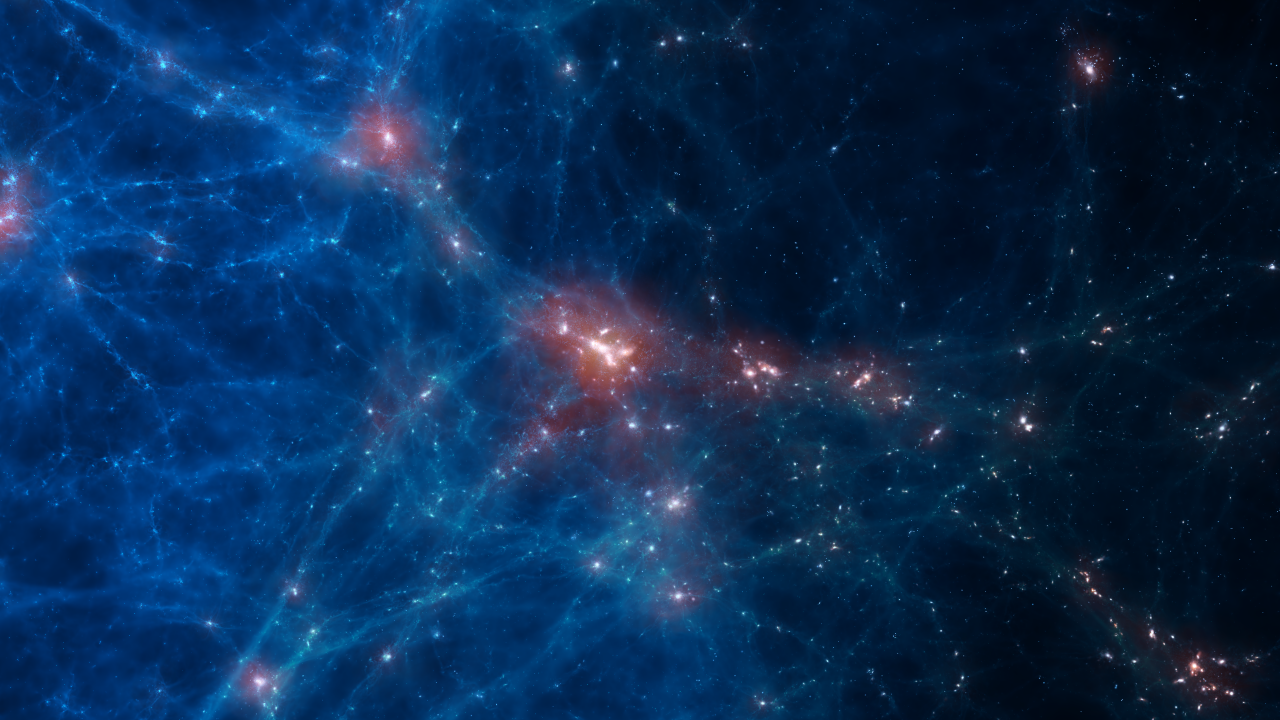
    Entre las cuestiones fundamentales en Astronomía y Astrofísica están la formación y evolución de galaxias. Las escalas de tiempo y tamaño son tan astronómicas que su observación en galaxias individuales es imposible. Solo con el uso de simulaciones numéricas es posible entender la formación de estructuras cósmicas dentro del actual marco cosmológico.

    Los principales procesos físicos que rigen la formación y evolución de galaxias son gravedad, hidrodinámica, gas cooling, formación estelar, evolución estelar, y SN y BH feedback, todos ellos no lineales y por ello difíciles de describir con modelos puramente analíticos. Otros modelos, los semi-analíticos, se basan en simulaciones de únicamente materia oscura y están, por tanto, sesgados al igual que éstas. Por todo esto, las simulaciones cosmológicas hidrodinámicas son la mejor herramienta para realizar los “experimentos controlados” de formación y evolución de galaxias.

    Tras tres décadas de mejoras en las simulaciones numéricas, solo ahora los trabajos teóricos pueden reproducir simultáneamente las propiedades observadas de las galaxias y del medio interestelar (e.g. EAGLE, Schaye et al. 2015, MNRAS, 446, 521; ILLUSTRIS, Vogelsberger et al., 2014, Nature, 509, 177); en particular, las funciones de luminosidad y de masa de las galaxias, las relaciones entre tamaño y masa, entre metalicidad y masa, entre otras muchas propiedades están reproducidas en un amplio rango de masas de galaxias.

    El grupo de astrofísica numérica trabaja en una variedad de temas científicos relacionados con la evolución de las galaxias y la estructura a gran escala del universo. La experiencia abarca desde la estructura interna de las galaxias enanas y de bajo brillo superficial, la Vía Láctea y sus galaxias satélite, el estudio de las galaxias en grupos y agrupaciones, hasta las grandes simulaciones cosmológicas de la estructura del universo. El grupo colabora con la mayoría de los grupos de investigación de IAC que trabajan en astrofísica extragaláctica y cosmología.
    Investigador principal
    Co investigador principal

    Publicaciones relacionadas

    Pericentric passage-driven star formation in satellite galaxies and their hosts: CLUES from local group simulations 2021MNRAS.506..531D
    Origin of stellar prolate rotation in a cosmologically simulated faint dwarf galaxy 2021MNRAS.505L.100C
    History of the gas fuelling star formation in EAGLE galaxies 2021MNRAS.505.4655S
    Higher order Hamiltonian Monte Carlo sampling for cosmological large-scale structure analysis 2021MNRAS.502.3976H
    Evaluating hydrodynamical simulations with green valley galaxies 2021MNRAS.502.3685A
    Self-interacting dark matter and the delay of supermassive black hole growth 2021MNRAS.500.2177C
    Stellar splashback: the edge of the intracluster light 2021MNRAS.500.4181D
    The discovery of the most UV-Ly α luminous star-forming galaxy: a young, dust- and metal-poor starburst with QSO-like luminosities 2020MNRAS.499L.105M
    The First Billion Years project: Finding infant globular clusters at z = 6 2020A&A...641A.132P
    NIHAO XXIV: rotation- or pressure-supported systems? Simulated Ultra Diffuse Galaxies show a broad distribution in their stellar kinematics 2020MNRAS.497.4282C
    Constraining the inner density slope of massive galaxy clusters 2020MNRAS.496.4717H
    Explaining the chemical trajectories of accreted and in-situ halo stars of the Milky Way 2020MNRAS.495.2645B
    Kinematic analysis of eagle simulations: evolution of λ<SUB>Re</SUB> and its connection with mergers and gas accretion 2020MNRAS.494.5652W
    The mass of our Galaxy from satellite proper motions in the Gaia era 2020MNRAS.494.5178F
    Sub one per cent mass fractions of young stars in red massive galaxies 2020NatAs...4..252S
    The intracluster light as a tracer of the total matter density distribution: a view from simulations 2020MNRAS.494.1859A
    Deep spectroscopy in nearby galaxy clusters - V. The Perseus cluster 2020MNRAS.494.1681A
    Signatures of the Galactic bar in high-order moments of proper motions measured by Gaia 2020A&A...634A..90P
    One simulation to have them all: performance of the Bias Assignment Method against N-body simulations 2020MNRAS.491.2565B
    The Pristine survey - VI. The first three years of medium-resolution follow-up spectroscopy of Pristine EMP star candidates 2019MNRAS.490.2241A
    Machine learning in APOGEE. Identification of stellar populations through chemical abundances 2019A&A...629A..34G
    Formation of ultra-diffuse galaxies in the field and in galaxy groups 2019MNRAS.487.5272J
    Conditions for Reionizing the Universe with a Low Galaxy Ionizing Photon Escape Fraction 2019ApJ...879...36F
    A distance of 13 Mpc resolves the claimed anomalies of the galaxy lacking dark matter 2019MNRAS.486.1192T
    NIHAO XXI: the emergence of low surface brightness galaxies 2019MNRAS.486.2535D
    The signal of decaying dark matter with hydrodynamical simulations 2019MNRAS.485.4071L
    Disruption of satellite galaxies in simulated groups and clusters: the roles of accretion time, baryons, and pre-processing 2019MNRAS.485.2287B
    Comparing approximate methods for mock catalogues and covariance matrices II: power spectrum multipoles 2019MNRAS.485.2806B
    Dark matter response to galaxy assembly history 2019A&A...622A.197A
    Galaxies with monstrous black holes in galaxy cluster environments 2019MNRAS.485..396V
    Comparing approximate methods for mock catalogues and covariance matrices - I. Correlation function 2019MNRAS.482.1786L
    The Cluster-EAGLE project: a comparison of dynamical mass estimators using simulated clusters 2019MNRAS.482.3308A
    Comparing approximate methods for mock catalogues and covariance matrices - III: bispectrum 2019MNRAS.482.4883C
    A case study of hurdle and generalized additive models in astronomy: the escape of ionizing radiation 2019MNRAS.483.3307H
    Gaia DR2 proper motions of dwarf galaxies within 420 kpc. Orbits, Milky Way mass, tidal influences, planar alignments, and group infall 2018A&A...619A.103F
    Stellar feedback and the energy budget of late-type Galaxies: missing baryons and core creation 2018MNRAS.480.4287K
    CLUES about M33: the reversed radial stellar age gradient in the outskirts of Triangulum galaxy 2018MNRAS.480.4455M
    On the early evolution of Local Group dwarf galaxy types: star formation and supernova feedback 2018MNRAS.479.1514B
    Spectroscopic characterization of the stellar content of ultra-diffuse galaxies 2018MNRAS.478.2034R
    Signatures of the Galactic bar on stellar kinematics unveiled by APOGEE 2018MNRAS.478.1231P